
Trust isn’t built through constant self-promotion. It emerges when you consistently share valuable content from credible sources, add meaningful perspective, and demonstrate genuine expertise through thoughtful curation.
Content curation creates trust by positioning you as a reliable filter in an information-saturated world. When you curate content effectively, you show your audience that you understand their challenges, stay informed about industry developments, and prioritise their needs over promotional agendas.
This trust translates directly into business outcomes. Your curated content becomes a bridge between scattered information and actionable insight, establishing you as a thought leader who delivers consistent value.
The following sections explain how strategic content curation builds credibility, positions you as a trusted authority, and creates lasting audience relationships. You’ll discover practical frameworks for selecting reliable sources, adding your unique perspective, and maintaining the transparency that makes curation powerful.
What Content Curation Actually Means for Building Trust
Content curation means discovering, organising, and sharing third-party content that provides genuine value to your audience. Unlike content creation, which requires generating original material, curation focuses on filtering and contextualising existing information.
The business meaning extends beyond simple sharing. When you curate content, you’re making editorial decisions that reflect your expertise and understanding of audience needs.
Effective curation requires three core elements: source selection, context addition, and consistent delivery. Each element contributes to the trust equation differently.
Source selection demonstrates your judgement and industry knowledge. The sources you choose signal which voices you respect and which standards you uphold.
Context addition shows your unique perspective. Original commentary transforms shared content from passive reposting into active thought leadership.
Consistent delivery builds reliability. Your audience learns they can depend on you for valuable insights without wading through promotional noise.
This foundation supports everything that follows. Understanding what curation truly involves helps you avoid common mistakes that erode credibility rather than building it.
How Curation Establishes Credibility Through Trust Dimensions
Trust is shaped by three main dimensions: functional, relational, and integrity. Content curation addresses each dimension when executed properly.

Functional trust develops when you consistently deliver valuable curated content. Your audience learns that following you saves time because you’ve already filtered quality information.
Relational trust grows through authentic engagement. When you curate content and respond thoughtfully to questions, you demonstrate genuine interest in audience success.
Integrity trust emerges from transparency. Crediting original sources and avoiding deceptive practices shows you operate with honesty.
Why Quality Curation Builds Functional Trust
Functional trust answers a simple question: does this person deliver what they promise? Every piece of curated content either reinforces or undermines this trust dimension.
When you share an insightful article from a credible source, you prove your ability to identify valuable information. This reliability compounds over time.
Your curation choices reflect your understanding of audience challenges. Sharing content that directly addresses their pain points demonstrates functional expertise.
Consistency matters enormously here. Sporadic curation fails to build trust because audiences can’t depend on you as a reliable information source.
Building Relational Trust Through Engagement
Relational trust requires human connection. Pure content sharing without engagement feels transactional and distant.
Add context explaining why each curated piece matters to your audience. This commentary creates connection between abstract information and practical application.
Respond to comments and questions about your curated content. These interactions transform one-way broadcasting into genuine dialogue.
Your engagement patterns signal whether you view your audience as metrics or as people. Authentic interaction builds relational credibility that pure curation cannot achieve alone.
Demonstrating Integrity Through Transparent Curation
Integrity trust depends on consistent ethical behaviour. Content curation offers numerous opportunities to demonstrate or violate this principle.
Always credit original sources properly. This basic practice shows respect for content creators and honesty with your audience.
Avoid manipulating shared content to fit your agenda. Misrepresenting someone else’s work destroys integrity faster than almost any other mistake.
Be transparent about any affiliations or partnerships when sharing third-party content. Hidden agendas erode trust immediately when discovered.
Thought Leadership Through Strategic Content Curation
Thought leadership and content curation complement each other powerfully. Many assume thought leaders must create everything from scratch, but strategic curation actually accelerates authority building.
A thought leader synthesises diverse perspectives and identifies emerging patterns. Curation provides the raw material for this synthesis.
When you consistently curate cutting-edge research, thoughtful analysis, and diverse viewpoints, you position yourself at the centre of important conversations. Your audience begins viewing you as the go-to source for staying informed.
How Curation Demonstrates Industry Expertise
Your curation choices reveal your industry knowledge depth. Sharing obscure but valuable sources shows you monitor the field beyond obvious mainstream outlets.
Curating content before it becomes widely circulated demonstrates you’re ahead of trends rather than following them. This forward-thinking approach builds thought leader perception.
The variety of sources you curate matters significantly. Drawing from academic research, practitioner insights, and emerging voices shows comprehensive field understanding.
Adding Commentary That Establishes Authority
Original commentary transforms curation from aggregation into thought leadership. Your perspective distinguishes you from others sharing the same content.
Analyse implications that others might miss. When you curate an industry study, explain what it means for different audience segments.
Connect curated content to broader trends. This synthesis ability marks true thought leaders who see patterns across disparate information.
Challenge assumptions when appropriate. Respectful disagreement with curated sources demonstrates independent thinking and confident expertise.
Building Thought Leadership Consistency
Thought leadership requires sustained visibility. Regular curation maintains your presence without demanding constant original content creation.
Develop content themes that align with your expertise areas. Consistent thematic curation reinforces your authority in specific domains.
Balance curated content with original insights. Finding the right mix of curated and original content strengthens thought leadership more effectively than either approach alone.
Key Benefits of Content Curation for Your Brand
Beyond trust and thought leadership, content curation delivers practical business benefits. Understanding these advantages helps justify the time investment required for quality curation.
Resource efficiency stands out immediately. Creating original content demands significant time and expertise, whilst curation leverages existing high-quality material.
Audience engagement typically increases with strategic curation. Diverse content types and perspectives keep your feed interesting and valuable.
Consistency becomes achievable. Maintaining regular posting schedules proves easier when you combine original and curated content.
Time and Resource Savings
Content creation requires substantial investment. Research, writing, editing, and production consume resources that many businesses struggle to allocate consistently.
Curation reduces this burden significantly. Finding and sharing excellent existing content takes far less time than creating comparable original material.
These time savings enable more frequent audience contact. Rather than posting original content monthly, you might share valuable curated content several times weekly.
The efficiency extends beyond time. Financial resources spent on content production can be redirected toward distribution and engagement when curation fills content gaps.
Enhanced Audience Engagement and Value Delivery
Audiences benefit from diverse perspectives. Curating multiple viewpoints on important topics provides more comprehensive value than single-source content.
Engagement often increases because curated content introduces variety. Your audience encounters different writing styles, formats, and approaches whilst maintaining topical relevance.
Value perception improves when you consistently deliver useful information. Content that focuses on helping rather than selling builds stronger audience relationships.
Your audience saves time because you’ve already filtered valuable content from noise. This service builds loyalty as people come to depend on your curation judgement.
Building Community Through Shared Content
Curation creates connection opportunities. Tagging original content creators when sharing their work often sparks conversations and relationship building.
Your curated content can spotlight community members and their contributions. This recognition strengthens community bonds whilst providing valuable content.
Shared content serves as conversation starters. Asking your audience to discuss curated articles generates engagement and reveals their perspectives.
Content Curation Versus Content Creation
Understanding the distinction between curation and creation helps you leverage each approach effectively. These strategies serve different purposes and deliver complementary benefits.
Original content establishes your unique voice and proprietary insights. It demonstrates deep expertise on specific topics where you possess special knowledge.
Curated content broadens your reach and maintains consistency. It positions you as a knowledgeable filter and industry observer without requiring constant original creation.
The most effective content strategies combine both approaches strategically. Neither alone delivers optimal results for building trust and credibility.
When Original Content Builds More Trust
Original content proves essential for establishing foundational expertise. Your unique perspectives, methodologies, and experiences cannot be curated from other sources.
Complex topics requiring deep explanation benefit from original content. When you need to educate audiences on specialised subjects, creation outperforms curation.
Proprietary research, case studies, and data demand original content. These materials differentiate you from competitors and establish unique authority.
When Curated Content Serves Better
Breaking news and time-sensitive information suit curation perfectly. Sharing rapid updates from trusted sources provides more value than delayed original commentary.
Diverse perspectives on controversial topics benefit from curation. Sharing multiple viewpoints demonstrates balanced thinking without requiring you to argue every position personally.
Maintaining posting consistency becomes easier with curation. When original content production lags, quality curated content keeps your audience engaged.
Creating an Effective Balance
Most successful content strategies follow an 80-20 or 70-30 balance. The majority consists of curated content supplemented by strategic original pieces.

Use original content for cornerstone topics central to your expertise. These signature pieces establish your unique position and perspective.
Fill gaps with curated content that reinforces your themes. Select third-party content supporting your viewpoints whilst adding complementary perspectives.
Track engagement metrics for both content types. Understanding what resonates helps refine your curation-creation balance over time.
Finding and Selecting Reliable Sources for Curation
Source quality determines curation effectiveness. Sharing unreliable information damages credibility faster than almost any other mistake.
Developing a robust source evaluation framework protects your reputation. This systematic approach ensures consistent quality across all curated content.
Reliable sources share common characteristics. Understanding these markers helps you quickly assess potential content for curation.
Identifying Credible Sources
Credible sources demonstrate expertise through author credentials and publication standards. Check whether authors possess relevant qualifications and experience.
Publication reputation matters significantly. Established industry publications typically maintain editorial standards that individual blogs might lack.
Transparency indicates reliability. Credible sources cite their own sources, acknowledge limitations, and avoid misleading clickbait headlines.
Regular auditing helps maintain source quality. Periodically review whether sources you’ve trusted continue meeting credibility standards.
Building Your Source Library
Creating a curated source list streamlines content discovery. Identify 10-15 consistently reliable sources covering your industry and audience interests.
Include diverse source types in your library. Mix academic research, industry publications, practitioner blogs, and news outlets for comprehensive coverage.
Monitor emerging voices alongside established authorities. New perspectives often provide fresh insights that mainstream sources miss.
Use RSS feeds or content discovery tools to track your sources efficiently. Content curation tools automate much of the discovery process.
Avoiding Unreliable Content
Red flags signal potentially unreliable sources. Extreme claims, lack of citations, and sensationalist language warrant scepticism.
Unknown sources require extra vetting. When discovering new publishers, investigate their background and track record before sharing their content.
Bias exists in all sources but excessive bias undermines credibility. Seek sources that acknowledge complexity rather than presenting simplistic narratives.
Adding Your Unique Voice and Perspective
Raw content sharing without context provides minimal value. Your original commentary transforms curation from passive reposting into valuable thought leadership.
Commentary serves multiple purposes simultaneously. It demonstrates your expertise, helps audiences understand relevance, and distinguishes your curation from others sharing identical content.
Effective commentary balances brevity with insight. You need sufficient substance to add value without overwhelming the curated content itself.
Types of Valuable Commentary
Contextual commentary explains why the curated content matters now. Connect it to current events, emerging trends, or audience challenges.
Analytical commentary highlights key insights audiences might miss. Point out significant implications, hidden assumptions, or important connections.
Practical commentary bridges theory and application. Explain how audiences can implement ideas from curated content in their specific situations.
Critical commentary offers balanced evaluation. Acknowledge both strengths and limitations of curated content, demonstrating independent thinking.
Commentary Best Practices
Read content thoroughly before commenting. Superficial commentary based on headlines damages credibility when audiences read the full piece.
Keep commentary concise but substantive. Aim for 2-4 sentences that add genuine insight without requiring extensive reading time.
Maintain consistent voice across commentary. Your perspective should feel authentic and aligned with your overall brand communication style.
Avoid simply summarising curated content. Your audience can read summaries in the original piece; provide additional value through unique perspective.
Balancing Commentary and Content
Commentary should enhance rather than overshadow curated content. When your comments become longer than the shared piece, consider creating original content instead.
Vary commentary depth based on content complexity. Straightforward articles might need brief context whilst complex research benefits from detailed analysis.
Test different commentary approaches with your audience. Track engagement to understand which commentary styles resonate most effectively.
Best Practices for Curating Content That Builds Trust
Implementing proven curation practices accelerates trust building. These guidelines synthesise the principles covered throughout this article into actionable standards.
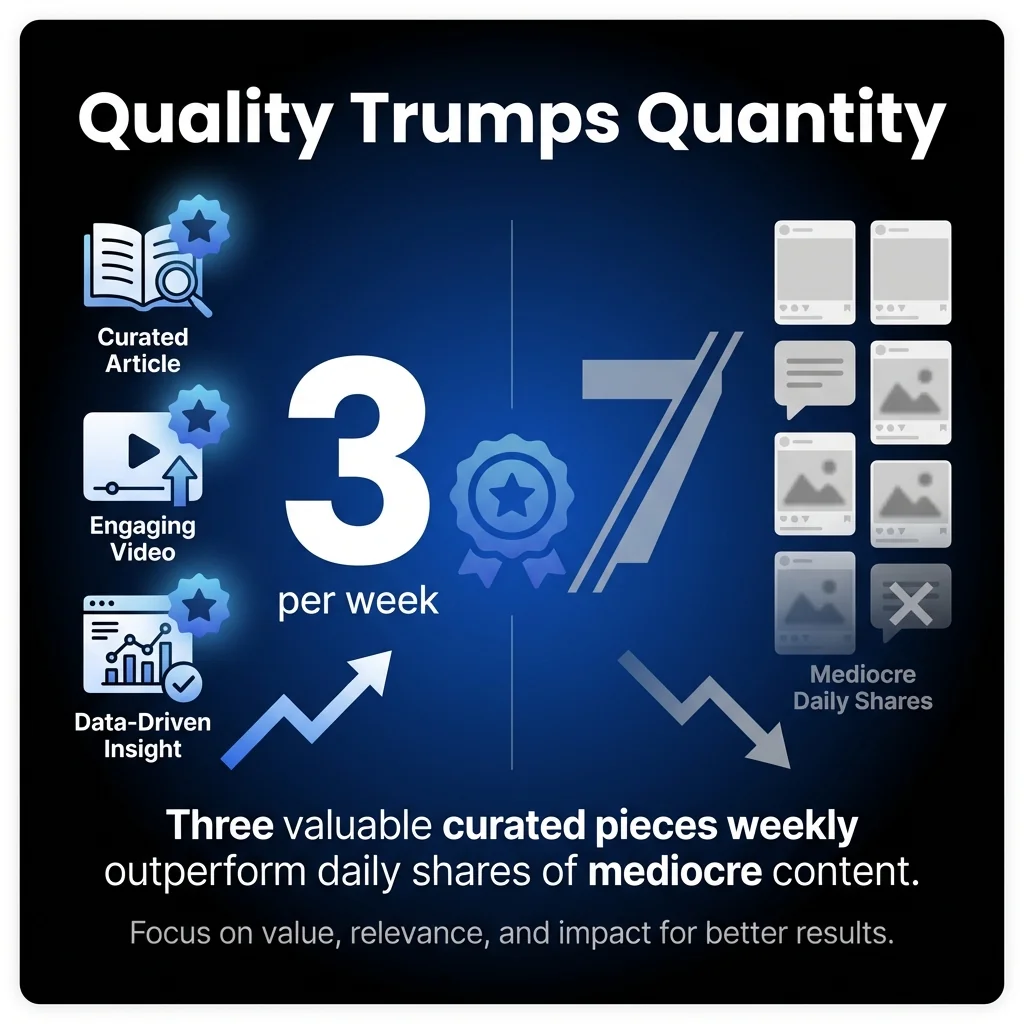
Quality consistently trumps quantity in content curation. Sharing fewer high-value pieces builds more trust than flooding audiences with mediocre content.
Transparency and proper attribution form the ethical foundation of curation. These practices protect your reputation whilst respecting original creators.
Prioritising Quality Over Quantity
Resist pressure to maintain arbitrary posting frequencies. Three valuable curated pieces weekly outperform daily shares of mediocre content.
Apply strict quality filters before sharing. Each piece should meet high standards for accuracy, insight, and relevance to audience needs.
Regular content beats perfect content. Consistency matters more than waiting for ideal pieces, but never compromise fundamental quality standards.
Proper Attribution and Copyright Compliance
Always credit original sources with clear attribution. Include author names, publication names, and direct links to source material.
Understand copyright limitations on content sharing. Brief excerpts with commentary typically fall under fair use, but sharing entire articles without permission violates copyright.
Seek permission when republishing substantial portions. Many publishers appreciate quality curation but require explicit permission for extensive excerpts.
Tag original creators on social media when sharing their work. This courtesy often sparks relationships whilst ensuring proper credit.
Maintaining Transparency With Your Audience
Brands that deliver reliably, act with transparency, and respond to the issues people care about can provide a sense of stability. This principle applies directly to content curation.

Disclose any relationships with sources you curate. Financial relationships, partnerships, or affiliations require transparent acknowledgement.
Distinguish clearly between curated and original content. Audiences should never feel misled about content origins.
Acknowledge when you’ve changed perspectives. If you previously shared content you now disagree with, transparency about this evolution builds rather than erodes trust.
Organising and Scheduling Your Curated Content
Strategic organisation transforms random curation into systematic trust building. Developing sustainable workflows ensures consistency without overwhelming time demands.
Content scheduling balances timeliness with sustainability. You need systems supporting regular sharing without requiring constant real-time attention.
Organisation extends beyond scheduling to thematic coherence. Your curated content should tell a cohesive story rather than appearing randomly selected.
Building an Efficient Curation Workflow
Dedicate specific time blocks for content discovery. Batch processing curation tasks proves more efficient than constant ad-hoc searching.
Create a staging system for potential shares. Collect interesting content in a centralised location, then evaluate and schedule during dedicated curation sessions.
Develop evaluation criteria for quick decisions. Clear standards help you rapidly assess whether content meets your curation requirements.
Content curation automation tools streamline discovery and scheduling, making consistent curation sustainable long-term.
Strategic Scheduling for Maximum Impact
Schedule curated content during high-engagement periods. Analyse when your audience is most active and schedule accordingly.
Space similar content appropriately. Avoid sharing multiple pieces on identical topics in quick succession unless covering breaking developments.
Balance timely and evergreen curation. Mix current events with timeless insights for sustained value delivery.
Maintain flexibility for breaking news. Automated scheduling shouldn’t prevent you from sharing time-sensitive developments as they occur.
Creating Thematic Content Calendars
Plan curation themes aligned with audience interests and business goals. Monthly or quarterly themes provide coherent narratives across curated content.
Coordinate curation with original content. Use curated content to support and amplify themes from your original pieces.
Track content diversity across categories. Ensure you’re providing balanced coverage across topics relevant to your audience.
Measuring Trust and Engagement From Curation
Understanding curation impact helps refine your approach. Whilst trust manifests gradually, specific metrics indicate whether your curation strategy works effectively.
Engagement metrics provide immediate feedback on content resonance. Comments, shares, and saves signal that curated content delivers value.
Long-term relationship indicators show trust development. Follower growth, repeat engagement, and direct messages reflect deepening audience connections.
Key Engagement Metrics to Monitor
Track engagement rates rather than vanity metrics. Percentage of audience interacting matters more than absolute numbers on individual posts.
Monitor share and save rates specifically. These actions indicate content value beyond passive consumption.
Analyse which curated content types generate strongest engagement. Understanding preferences helps refine source selection and topic focus.
Compare engagement between curated and original content. This comparison reveals how effectively your curation complements creation.
Trust Indicators Beyond Metrics
Direct audience feedback signals trust development. Questions, thank-you messages, and content suggestions indicate genuine relationships forming.
Referral behaviour demonstrates trust. When audience members recommend you to others, they’re vouching for your credibility.
Collaboration opportunities often emerge as trust builds. Invitations to contribute, partner, or participate indicate growing professional reputation.
Experiences people have across a range of touchpoints shape perceptions. Monitor how your curation fits within broader audience experience.

Iterating Based on Performance Data
Review curation performance monthly or quarterly. Identify patterns in successful versus unsuccessful curated content.
Test variations systematically. Experiment with different sources, commentary styles, and posting frequencies whilst tracking results.
Solicit direct audience feedback periodically. Ask what content types provide most value and what they’d like to see more frequently.
Adjust strategies based on data patterns. Let evidence rather than assumptions guide your curation evolution.
Building Lasting Trust Through Consistent Curation
Content curation builds trust when executed with strategic intent and consistent quality. The framework covered here transforms curation from simple sharing into genuine relationship building.
Start by selecting reliable sources that reflect your standards and expertise. Your source choices signal your judgement and industry knowledge to audiences.
Add meaningful commentary that demonstrates your unique perspective. This original insight distinguishes you from others sharing identical content.
Maintain transparency through proper attribution and honest communication. The experience people have with products, services, communications and day-to-day interactions all need to point in the same direction for the promise to feel credible.
Balance curated content with original creation strategically. Neither approach alone delivers optimal trust building results.
Most importantly, commit to consistency. Trust develops through repeated positive experiences over extended periods.
Your next step involves auditing current curation practices. Review recent shares against the quality standards and attribution practices discussed here.
Then develop your source library and curation workflow. Sustainable systems enable the consistency that trust requires.
The credibility you build through thoughtful curation compounds over time. Each quality share reinforces your position as a trusted authority who consistently delivers value.