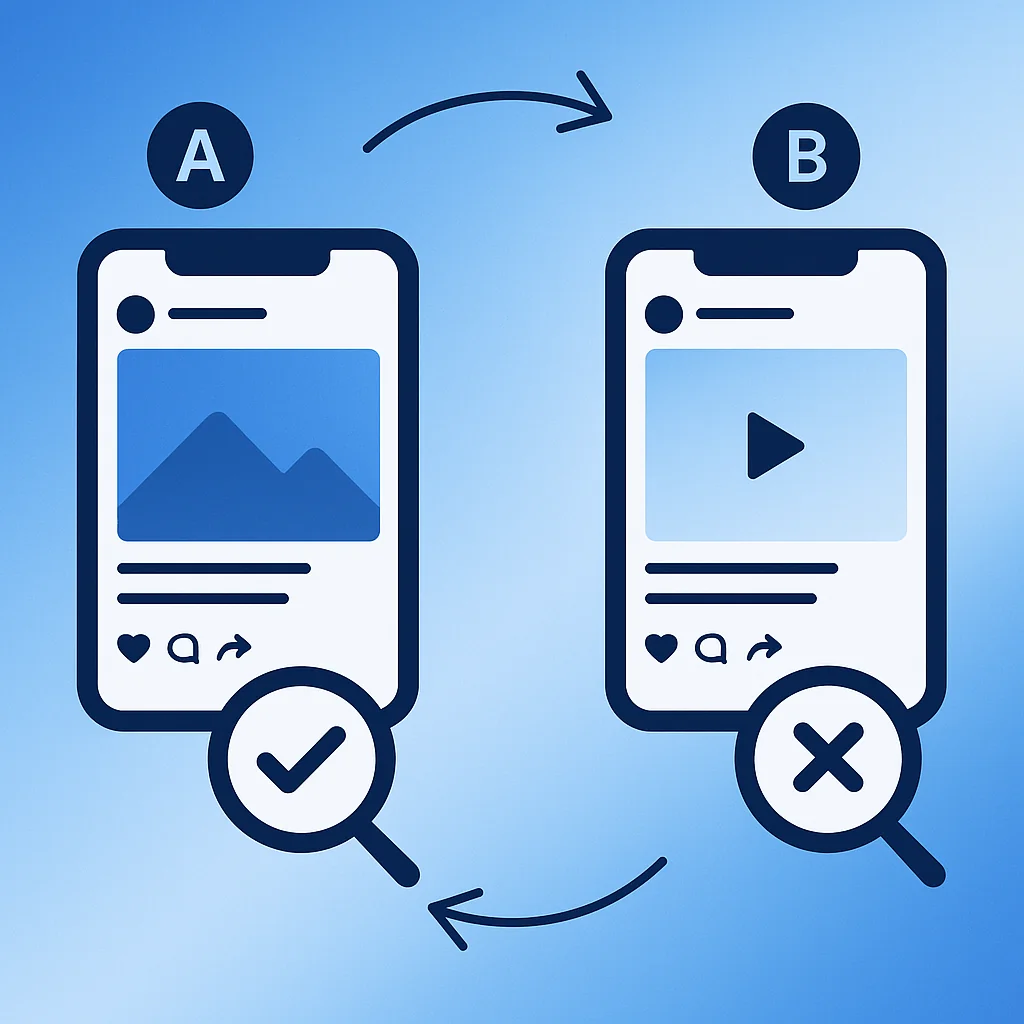
Testing different versions of your social media content is one of the most reliable ways to improve performance. A/B testing provides a scientific approach to improving social media performance, taking the guesswork out of what resonates with your audience.
Instead of posting once and hoping for engagement, A/B testing lets you compare two variations systematically. You might test different headlines, images, or calls to action to see which drives more clicks, shares, or conversions.
The data tells you exactly what works. No more relying on hunches or following generic best practices that might not apply to your specific audience. Split testing reveals the preferences of your followers, giving you concrete evidence to guide your content strategy.
This guide walks you through everything you need to run effective A/B tests on social media. You’ll discover which elements to test, how to set up experiments properly, and how to analyse results to make informed decisions about your content.
What A/B Testing Means for Social Media
A/B testing, often called split testing, compares two versions of a social media post to determine which performs better. A/B testing involves splitting users randomly into two groups, with each group seeing a different variation of your content.
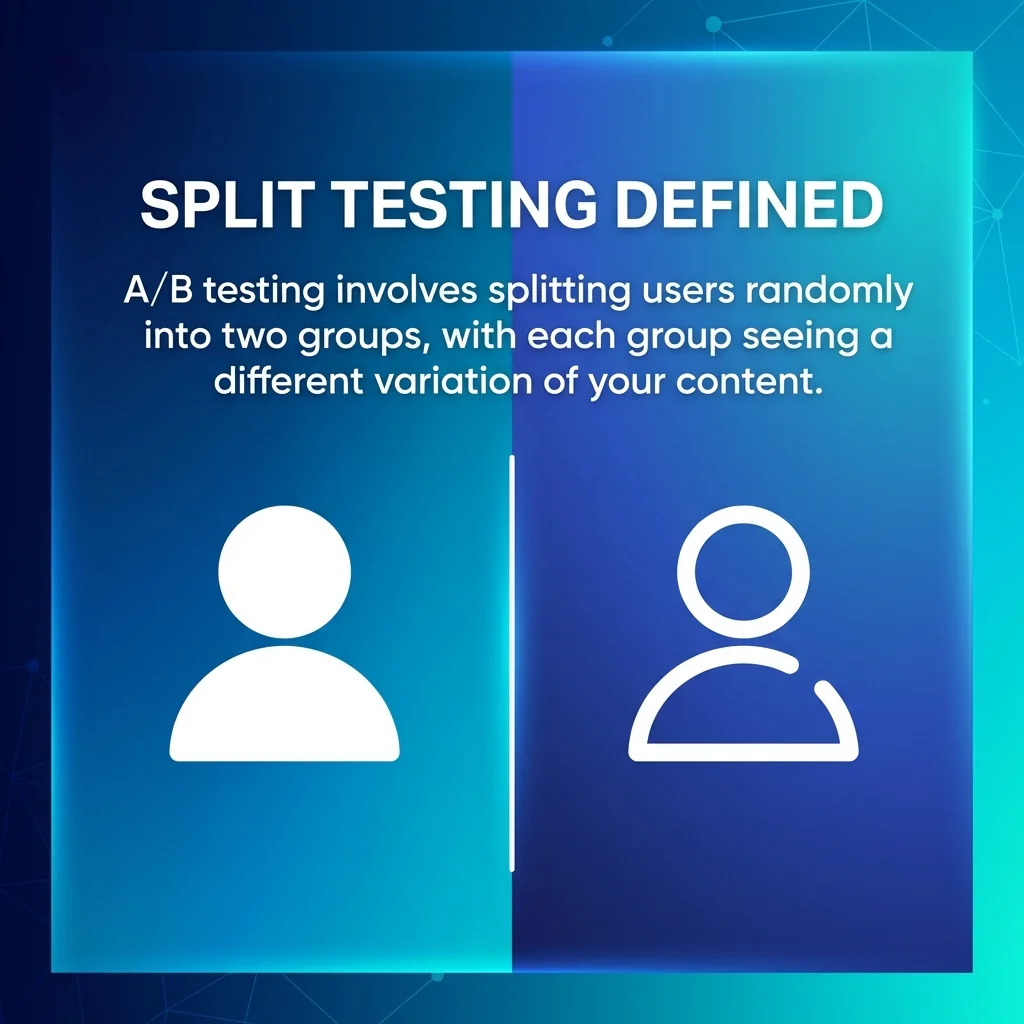
Version A serves as your control. This might be your current post format or design. Version B introduces a single change you want to test, such as a different image or headline.
The process is straightforward. You publish both versions simultaneously to similar audience segments. As users engage with each post, you track metrics like clicks, shares, comments, or conversions. After collecting sufficient data, you compare performance to identify the winner.
This method removes subjectivity from decision-making. Rather than debating which creative approach might work better, you let actual user behaviour provide the answer.
The Core Principle Behind Split Testing
The power of A/B testing lies in isolation. You change one variable at a time whilst keeping everything else constant. This allows you to attribute performance differences directly to that single change.
If you alter multiple elements simultaneously, you cannot determine which change drove the results. Did the new image boost engagement, or was it the revised headline? Testing one variable at a time provides clarity.
Randomisation ensures fairness. Each variation reaches a similar cross-section of your audience, preventing bias from skewing results. Without random assignment, you might accidentally show Version A to your most engaged followers and Version B to casual observers, invalidating your findings.
Why Social Media Demands Testing
Social platforms operate on algorithms that prioritise engaging content. Small improvements in early engagement can trigger significantly greater reach as the algorithm distributes your post more widely.
Audience preferences vary across platforms and demographics. What works brilliantly on LinkedIn might flop on Instagram. Testing reveals platform-specific insights you cannot assume from general best practices.
Trends shift rapidly on social media. An approach that drove engagement six months ago might not resonate today. Regular testing keeps your strategy aligned with current audience preferences.
Why A/B Testing Transforms Social Media Results
Split testing eliminates uncertainty from your content decisions. When you base choices on actual performance data rather than assumptions, you optimise for what truly matters: audience response.
Every social media manager faces countless decisions. Should you use a question or statement in your caption? Does a lifestyle photo outperform a product shot? Do emojis increase engagement or decrease professionalism?
Testing answers these questions definitively for your specific audience. The insights you gain compound over time, continuously improving your content effectiveness.
Measurable Performance Improvements
A/B testing produces quantifiable gains. You might discover that posts with questions in the first sentence generate 23% more comments. Or that bright backgrounds boost click-through rates by 15% compared to neutral tones.
These incremental improvements add up significantly across your entire content calendar. If you post five times weekly, even a 10% increase in engagement translates to hundreds of additional interactions monthly.
The data guides resource allocation. When testing reveals which content formats drive conversions, you can confidently invest more effort into creating similar posts whilst reducing time spent on underperforming approaches.
Audience Understanding Deepens Over Time
Each test teaches you something about your followers. You learn their preferences, pain points, and motivations through their interactions with different variations.
This knowledge extends beyond individual posts. Patterns emerge across multiple tests, revealing broader insights about what your audience values. Perhaps they consistently prefer educational content over promotional messaging, or respond better to testimonials than feature lists.
Understanding develops progressively. Your first test might reveal basic preferences. Subsequent tests build on those findings, uncovering more nuanced insights that inform sophisticated content strategies.
Risk Reduction Through Validation
Testing reduces the cost of mistakes. Before committing your entire audience to a new approach, you validate it with a subset. If the variation underperforms, you simply continue with your control version.
This safety net encourages experimentation. You can test bold creative ideas without risking your overall performance. The data either confirms your hypothesis or saves you from a poorly-performing campaign.
Validation becomes particularly valuable for significant changes. When redesigning your brand’s social presence or launching a new content theme, testing variants first prevents costly errors that might damage engagement or follower growth.
Elements You Can Test on Social Media
Nearly every component of a social post can be tested. The key is prioritising elements that meaningfully impact your goals, whether that’s engagement, traffic, or conversions.
Visual design choices impact engagement on social media, making images one of the highest-impact elements to test. Beyond visuals, your copy, timing, and calls to action all influence performance differently.

Visual Content Variations
Images drive immediate attention on social feeds. Test different photograph styles, such as lifestyle shots versus product-focused images. Colour schemes influence mood and visibility, with bright palettes often standing out against neutral feeds.
Video formats offer extensive testing opportunities. Compare short clips to longer content, talking-head presentations versus text overlays, or vertical versus square aspect ratios. Thumbnail selection for videos significantly affects initial engagement.
Graphic design elements matter too. Test typography choices, layout compositions, and the presence or absence of your logo. Even subtle changes like image filters can shift engagement patterns.
Copy Components
Headlines and opening sentences determine whether users stop scrolling. Test different hooks: questions versus statements, statistics versus stories, or curiosity gaps versus direct value propositions.
Caption length affects engagement differently across platforms. Compare concise captions to detailed explanations. Test whether leading with your main point outperforms building up to it.
Tone variations reveal audience preferences. Try conversational language against professional terminology, humour versus seriousness, or casual versus authoritative voices. The winning tone guides your broader content strategy.
Emoji usage represents another testable element. Some audiences engage more with emoji-rich posts whilst others prefer clean text. Location matters too: emojis in headlines versus scattered throughout captions produce different results.
Call-to-Action Formats
Your CTA directly influences conversion rates. Test explicit instructions (“Click the link in bio”) against subtle suggestions (“Learn more about this approach”). Compare question-based CTAs (“Ready to start?”) with command-based prompts (“Start your trial today”).
CTA placement affects visibility. Test calls to action at the beginning of captions versus the end, or in both locations. For platforms like Facebook, button text variations (“Learn More” versus “Shop Now”) can significantly impact click-through rates.
Posting Elements
Timing influences initial engagement velocity, which algorithms often reward. Test different days of the week and times of day. Your optimal posting schedule might differ significantly from generic best-practice recommendations.
Hashtag strategies vary widely. Compare posts with many hashtags versus few, branded hashtags versus popular ones, or hashtags in captions versus comments. Effectiveness differs dramatically across platforms and industries.
Post formats themselves warrant testing. On platforms like LinkedIn, single images might perform differently than carousel posts or text-only updates. Understanding which formats your audience prefers optimises your content production efforts.
How to Run an A/B Test on Social Media Step-by-Step
Successful testing follows a structured process. Rushing through setup or skipping analysis steps produces unreliable results that can mislead your strategy.
The methodology ensures validity. Each step builds on the previous one, creating conditions where you can confidently attribute performance differences to the variable you’re testing rather than external factors.
Step 1: Define Your Testing Objective
Start with a clear goal tied to business outcomes. Are you optimising for engagement, traffic, or conversions? Each objective requires tracking different metrics.
Specific goals produce actionable results. “Increase engagement” is too vague. “Increase comments by testing question-based versus statement-based opening sentences” provides focus.
Your objective determines which variation wins. A post might generate more likes but fewer clicks. Without a predetermined goal, you cannot objectively declare a winner.
Step 2: Formulate Your Hypothesis
State what you believe will happen and why. Create a variation based on your hypothesis of what might work better in A/B testing.
A proper hypothesis sounds like: “Posts with bright, high-contrast images will generate higher click-through rates than muted tones because they stand out in crowded feeds.” This statement is testable and includes reasoning.
Document your hypothesis before seeing results. This prevents post-hoc justification where you explain away unexpected outcomes rather than learning from them.
Step 3: Identify Your Single Test Variable
Choose one element to change between Version A and Version B. Keep everything else identical: posting time, audience, caption (except the variable), and platform.
Changing multiple elements simultaneously creates ambiguity. If you alter both the image and headline, you cannot determine which change influenced performance.
Common mistakes include using different post types or posting at different times. These introduce confounding variables that invalidate your results.
Step 4: Create Your Variations
Develop Version A (control) and Version B (variation). The control typically represents your current approach. The variation implements the change you’re testing.
Make the difference meaningful but not extreme. Testing a product photo against a completely unrelated image tells you little. Testing a product photo against a lifestyle image showing the product in use provides useful insights.
Ensure both versions maintain quality. A poorly-designed variation losing to a polished control teaches you nothing about the variable itself.
Step 5: Determine Your Sample Size
For organic social media posts, you should aim for at least 500–1,000 impressions per variant to achieve reliable results. Smaller samples introduce too much randomness.
Paid social media allows precise audience splitting. Most advertising platforms include built-in A/B testing tools that automatically divide your budget between variations and track performance.
For organic posts, consider your typical reach. If your posts average 2,000 impressions, running a test makes sense. If you typically reach only 200 people, results may lack statistical significance.
Step 6: Run the Test Simultaneously
Deploy both variations at the same time to identical audiences. This controls for external factors like time of day, day of week, or current events that might influence engagement.
On platforms allowing multiple posts, use audience targeting to split your followers randomly. Alternatively, run the test across different platforms with similar audiences, though this introduces additional variables.
Maintain the test long enough to gather sufficient data. A few hours rarely provides reliable results. Most organic posts need 24-72 hours to accumulate meaningful engagement.
Step 7: Track Relevant Metrics
Monitor metrics aligned with your objective. For engagement goals, track likes, comments, shares, and saves. For traffic goals, focus on click-through rates. For conversion goals, measure actions taken after clicking.
Record results systematically. Create a spreadsheet tracking each variation’s performance across all relevant metrics. This documentation helps identify patterns across multiple tests.
Look beyond surface-level metrics. A variation might generate more likes but fewer meaningful comments. Consider which outcome better serves your goals.
Step 8: Analyse Results for Statistical Significance
Determine whether performance differences are meaningful or merely random variation. Statistical significance indicates the likelihood that your results would replicate in future tests.
Many A/B testing calculators are available online. Input your metrics to receive a confidence level. Generally, 95% confidence or higher suggests reliable results.
Avoid declaring winners prematurely. A variation leading by a small margin after two hours might not maintain that advantage over 48 hours. Patience produces reliable conclusions.
Step 9: Implement Findings
Apply insights from winning variations to future content. If bright images outperformed muted tones, prioritise vibrant visuals going forward.
Document your findings. Maintain a testing log noting what you tested, results, and conclusions. This knowledge base guides future strategy decisions and prevents retesting the same variables.
Continue testing. Each result raises new questions. If blue backgrounds won, test blue against other colours. If questions boosted engagement, test different question formats. Continuous testing compounds improvements over time.
Platform-Specific A/B Testing Approaches
Each social platform offers different testing capabilities and audience behaviours. Understanding platform-specific considerations ensures valid results and efficient testing processes.
Built-in testing tools vary significantly. Some platforms provide sophisticated split-testing features, whilst others require manual workarounds. Adapting your methodology to each platform’s constraints produces better outcomes.
Facebook A/B Testing
Facebook provides robust testing tools through Ads Manager. The platform’s split testing feature automatically divides your audience, distributes budget evenly, and reports results with statistical significance indicators.
For organic posts, testing is less straightforward. You might publish both variations to different segments using audience restrictions, though this limits reach. Alternatively, test variations across different time periods, though this introduces temporal variables.
Facebook’s algorithm prioritises early engagement. Initial performance in the first hour often predicts overall reach. Monitor variations closely during this critical window.
Test different post types: link posts versus video uploads, or native video versus YouTube embeds. The platform treats these formats differently in the algorithm, affecting distribution.
Instagram Testing Strategies
Instagram Stories offer excellent testing opportunities. Post both variations as separate stories simultaneously. Track completion rates, tap-forwards, and swipe-ups (if available) to identify winners.
Feed posts require more creativity. Test variations by posting at different times to similar audience segments. Acknowledge this introduces timing variables, but Instagram’s 48-hour engagement window makes simultaneous organic testing challenging.
Instagram’s visual focus makes image and video testing particularly valuable. Test aspect ratios (square versus vertical), content types (photos versus graphics versus videos), and visual styles (minimal versus busy compositions).
Caption testing reveals interesting insights. Instagram allows lengthy captions, so test detailed storytelling against concise hooks. The platform’s “more” button means most users only see the first few lines initially.
LinkedIn Testing Tactics
LinkedIn audiences often respond differently than other platforms. Professional contexts demand different content approaches, making assumptions from other platforms unreliable.
The platform’s algorithm favours posts that spark meaningful conversations. Test variations that encourage professional discussion versus those optimised for likes and shares.
Document and PDF posts perform uniquely on LinkedIn. Test these against standard image posts. Similarly, LinkedIn Articles offer a distinct format worth comparing to regular updates.
Timing matters significantly on LinkedIn due to professional schedules. Test weekday versus weekend posting, and morning versus evening times. Business hours often perform differently than other platforms.
TikTok Testing Considerations
TikTok‘s algorithm distributes content differently than follower-based platforms. The “For You” page exposes content to users who don’t follow you, making initial engagement velocity crucial.
Test video hooks in the first three seconds. TikTok users scroll rapidly, so capturing attention immediately determines whether viewers watch completely.
Sound choices significantly impact performance. Test trending sounds against original audio, or popular music versus voiceovers. The platform’s audio-first culture makes this variable particularly important.
Caption length and hashtag strategies vary on TikTok. Test minimal captions against descriptive ones. Similarly, compare trending hashtags to niche-specific tags.
Twitter/X Testing Methods
Twitter moves quickly, making timing tests valuable. Test identical tweets at different hours to identify optimal posting windows for your audience.
Thread format offers unique opportunities. Test standalone tweets versus thread openings. Compare threads that summarise upfront against those that build suspense.
Visual content performs differently on Twitter than image-focused platforms. Test tweets with images against text-only, or compare single images to multiple-image posts.
The platform’s character limit forces conciseness. Test different structures: question openings versus statements, or data-driven versus narrative approaches.
Analysing A/B Test Results Effectively
Data collection means nothing without proper analysis. The interpretation phase transforms raw numbers into actionable insights that improve your social media strategy.
Rushing to conclusions from insufficient data leads to poor decisions. Following a systematic analysis process ensures you extract maximum value from each test whilst avoiding common interpretation pitfalls.
Establishing Your Success Metrics
Before examining data, confirm which metrics determine the winner. This should align with the goal you set when designing the test.
Primary metrics directly measure your objective. If testing to increase traffic, click-through rate is your primary metric. Engagement rate matters less, even if one variation generates more likes.
Secondary metrics provide context. A variation might win on your primary metric but perform poorly elsewhere. Understanding the full picture prevents optimising one metric whilst damaging others.
Calculating Statistical Significance
Statistical significance indicates whether results reflect genuine differences or random chance. Without this calculation, you might declare a winner based on meaningless fluctuations.
Use an A/B test significance calculator. Input the number of visitors and conversions (or engagements) for each variation. The tool calculates whether differences are statistically meaningful.
Aim for 95% confidence or higher. This means there’s only a 5% chance the observed difference occurred randomly. Lower confidence levels suggest you should continue testing or accept results are inconclusive.
Sample size affects significance. Large performance differences with small samples might lack significance, whilst small differences with large samples can be highly significant. Both factors matter.
Looking Beyond Surface Numbers
Dig deeper than topline metrics. A variation generating 20% more clicks might attract unqualified traffic that bounces immediately. Check downstream metrics when possible.
Segment results by audience characteristics if data allows. A variation might perform brilliantly with one demographic whilst underperforming with another. These insights enable audience-specific optimisation.
Time-based analysis reveals patterns. Perhaps one variation starts strong but fades, whilst another maintains steady performance. Understanding these dynamics informs content strategy.
Identifying Unexpected Findings
Pay attention to surprises. When results contradict your hypothesis, you’ve learned something valuable about your audience. These unexpected insights often prove most useful.
Question anomalies. If one variation performs drastically better or worse than expected, investigate potential confounding factors. Was there a platform outage? Did a current event shift attention? Ensure external factors didn’t skew results.
Failed tests provide value. Learning that a change doesn’t improve performance prevents wasting resources on that approach. Failed tests also generate new hypotheses about what might work instead.
Documenting Test Results
Create a testing repository tracking each experiment. Record the date, hypothesis, variations tested, results, significance level, and conclusions. This historical record becomes increasingly valuable over time.
Include screenshots of both variations. Visual documentation helps when reviewing past tests to identify patterns or refresh your memory about specific experiments.
Note any contextual factors that might have influenced results. External events, platform changes, or concurrent campaigns provide important context for interpreting findings.
Building on Results
Each test conclusion raises new questions. A winning variation becomes the new control for subsequent tests. This iterative approach compounds improvements over time.
Look for patterns across multiple tests. If bright colours consistently outperform muted tones across various contexts, this represents a reliable insight worth implementing broadly.
Share findings with your team. Testing insights inform strategy beyond just post optimisation. Audience preferences revealed through social testing might guide website design, email marketing, or product development.
A/B Testing Best Practices for Social Media
Following established best practices maximises the reliability and value of your testing programme. These guidelines help you avoid common mistakes that waste time and produce misleading results.
Disciplined testing methodology separates meaningful insights from noise. Cutting corners might seem efficient initially, but poor practices generate unreliable data that damages decision-making.
Test One Variable at a Time
Isolating variables is fundamental to valid testing. Changing multiple elements simultaneously makes it impossible to attribute performance differences to specific changes.
If you test a new image with a new headline, you cannot determine which element drove results. The image might have performed brilliantly whilst the headline dragged down performance, or vice versa. The combined effect tells you nothing about individual components.
This discipline requires patience. Testing each element separately takes longer than throwing multiple changes together. However, the insights gained are actually useful for future decisions.
Ensure Sufficient Sample Sizes
Small samples produce unreliable results. Random variation can make inferior variations appear superior when sample sizes are inadequate.
Calculate required sample sizes before testing. Many online calculators determine the audience size needed to detect meaningful differences at your desired confidence level.
Resist declaring winners prematurely. Variation A might lead early but lose after more data accumulates. Complete the full testing period even if one variation jumps ahead initially.
Run Tests for Appropriate Durations
Short testing windows miss important patterns. Social media engagement often develops over 24-48 hours as posts reach different audience segments across time zones and checking schedules.
Account for weekly patterns. Testing only on Tuesdays might miss that your audience behaves differently on weekends. When possible, run tests across full weeks to capture varying behaviours.
Platform algorithms affect timing needs. TikTok distributes content rapidly, potentially providing results in hours. LinkedIn posts might need several days to reach their full audience.
Maintain Testing Consistency
Keep testing conditions as similar as possible between variations. Post both versions at the same time, to equivalent audience segments, with identical targeting parameters.
Document your testing setup. Record exact posting times, audience parameters, and any relevant context. This documentation helps interpret results and replicate successful tests.
Avoid testing during unusual periods unless specifically testing seasonal content. Major holidays, platform outages, or breaking news events can skew engagement patterns, producing results that won’t replicate normally.
Prioritise Impactful Tests
Not all tests warrant equal attention. Focus on variables likely to significantly impact your key metrics. Testing button colour might matter less than testing entirely different value propositions.
Consider potential upside. A test with possible 5% improvement demands less priority than one that might yield 50% gains. Balance test difficulty against potential value.
Start with foundational elements. Test major components like images and headlines before optimising minor details like emoji placement. Nail the basics before perfecting nuances.
Build Progressive Testing Programmes
Each test should build on previous learnings. Use winning variations as new controls for subsequent tests. This iterative approach compounds improvements over time.
Create testing roadmaps. Plan sequences of related tests that progressively optimise specific content types or campaigns. Strategic testing programmes generate more value than random one-off tests.
Retest periodically. Audience preferences shift over time. A test conducted six months ago might produce different results today. Revisit important findings annually to confirm they remain valid.
Common A/B Testing Mistakes to Avoid
Understanding pitfalls helps you sidestep problems that undermine testing effectiveness. These mistakes appear frequently, even amongst experienced marketers.
Awareness enables prevention. Recognising these patterns in your own testing process allows you to course-correct before investing significant resources in flawed experiments.
Ending Tests Too Early
Impatience undermines valid results. Stopping tests after a few hours because one variation leads ignores statistical principles and normal variation.
Early leaders often fade. Initial engagement might come from your most dedicated followers who don’t represent your broader audience. Later engagement provides a more accurate picture.
Set predetermined testing windows before starting. Commit to running the full duration regardless of interim results. This discipline prevents bias from influencing decisions.
Ignoring Statistical Significance
Declaring winners without checking significance leads to false conclusions. A variation performing 5% better might still lose if you ran the test again, especially with small samples.
Gut feelings cannot replace mathematical validation. You might feel confident about results, but without significance testing, you’re essentially guessing.
Use significance calculators for every test. This takes minutes and prevents basing strategy on unreliable data. Treat inconclusive results as learning opportunities, not failures.
Testing Too Many Variables Simultaneously
Multivariate testing has its place, but requires exponentially larger sample sizes. Testing three variables with two options each requires eight variations, dividing your audience eight ways.
Most social media accounts lack sufficient reach for complex multivariate tests. Sample sizes become too small per variation, destroying statistical validity.
Stick to simple A/B tests comparing two variations. Once you’ve optimised major elements individually, you can test combinations of proven winners if your audience size supports it.
Failing to Document Hypotheses
Testing without documented hypotheses enables post-hoc rationalisation. When you haven’t stated expected outcomes beforehand, it’s tempting to explain away unexpected results rather than learning from them.
Written hypotheses create accountability. They force you to articulate your reasoning and assumptions, which themselves often reveal flawed thinking worth reconsidering.
Documentation also builds institutional knowledge. Teams can review past hypotheses to understand strategic thinking and avoid repeating disproven assumptions.
Overreacting to Single Tests
One test rarely justifies major strategic pivots. Results might be flukes, influenced by temporary factors, or simply not representative of typical performance.
Look for patterns across multiple tests before drawing broad conclusions. If three separate tests show images with people outperform product-only shots, that’s a reliable insight. One test is a data point, not a mandate.
Consider the context of surprising results. Exceptional performance might stem from unusually strong creative execution rather than the variable being tested. Ensure you’re learning the right lesson.
Neglecting Mobile Versus Desktop Differences
Most social media usage occurs on mobile devices, yet some elements display differently across devices. An image that looks brilliant on desktop might appear cluttered on mobile.
Check how variations appear on different devices before testing. Ensure both versions display properly across formats, or you’re testing device compatibility rather than your intended variable.
When possible, segment results by device type. A variation might perform better on mobile but worse on desktop. Understanding device-specific preferences enables sophisticated optimisation.
Forgetting About Audience Overlap
Cross-platform audiences create complications. If someone follows you on both Instagram and Facebook, they might see both variations, confusing your test and annoying your follower.
Consider timing tests on different platforms to minimise overlap exposure. Run Facebook tests one week and Instagram tests the next, reducing the chance followers see multiple versions.
For significant overlap, acknowledge this limitation in your analysis. Results might be somewhat muddied, but patterns should still emerge if differences are meaningful.
Taking Your Social Media Testing Forward
A/B testing transforms social media from guesswork into science. The systematic approach reveals exactly what resonates with your audience, enabling data-driven decisions that continuously improve performance.
Start with high-impact elements like images and headlines. These variables typically show the largest performance differences and justify testing investments most clearly.
Build testing into your regular workflow. Rather than occasional experiments, make split testing a standard part of content creation. This consistency generates the data volume needed for reliable insights.
Successful social media campaigns rely on understanding what works for your specific audience. Testing provides that understanding, removing assumptions and replacing them with evidence.
Your first test matters less than starting. Begin with something simple: two different images on the same post concept. Analyse results, document findings, and run your next test. Each experiment builds your knowledge base.
The insights compound over time. Six months of consistent testing reveals patterns that transform your entire content strategy. You’ll know which formats drive engagement, which messages convert, and which approaches waste effort.
Measuring the ROI of your social media marketing strategy becomes straightforward when you test systematically. You can directly attribute performance improvements to specific changes, demonstrating the value of your optimisation efforts.
Remember that testing never truly ends. Audience preferences evolve, platforms change their algorithms, and new content formats emerge. Maintaining a testing mindset keeps your strategy effective amid constant change.
The marketers who test consistently outperform those who rely on best practices and assumptions. Your data beats generic advice every time. Start testing today, and let your audience tell you exactly what they want to see.