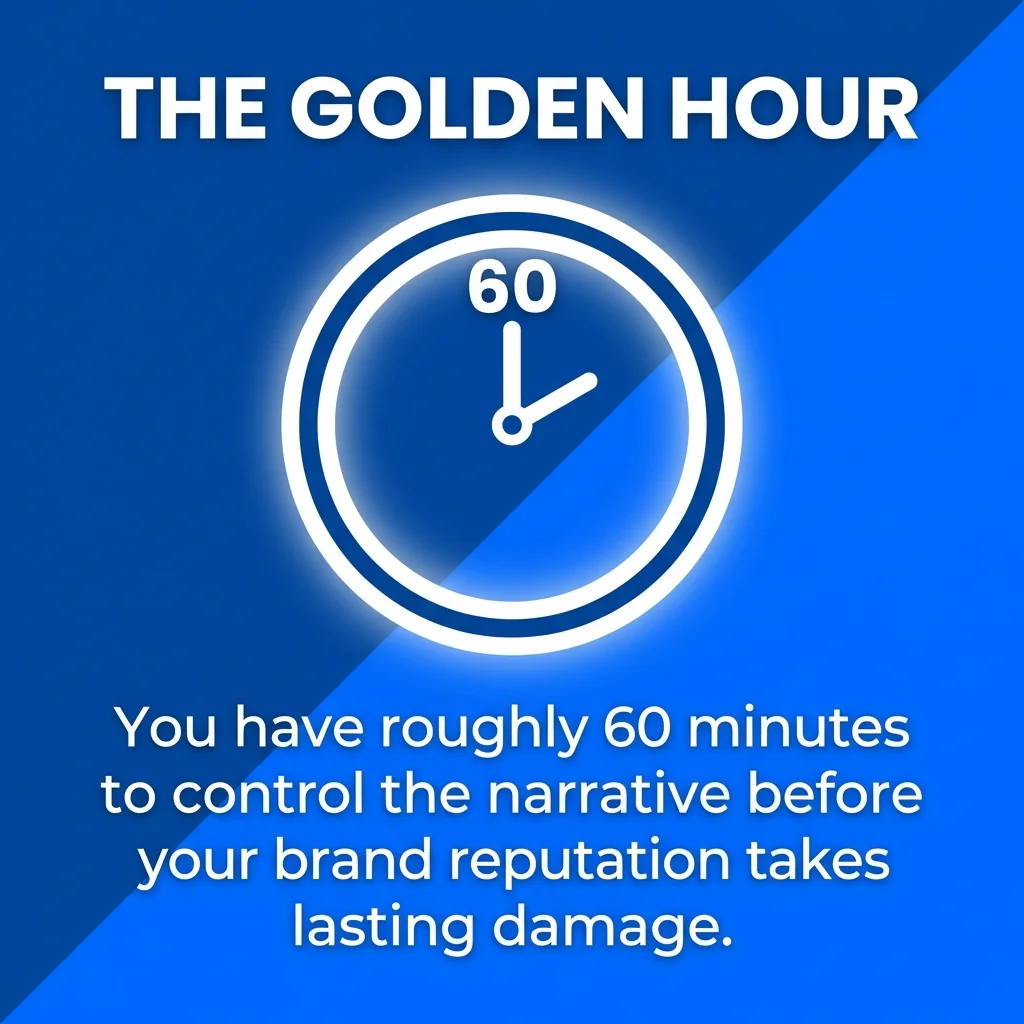
When your social media post backfires, you have roughly 60 minutes to control the narrative before your brand reputation takes lasting damage. Speed matters more than perfection. Taking responsibility immediately whilst monitoring sentiment in real time determines whether you recover quickly or face months of reputation repair work. Delete or keep the post? That decision depends on whether the content violates platform policies or simply misses the mark with your audience.
Every social media mistake follows a predictable crisis management path. First comes the rapid assessment phase where you determine severity and legal implications. Then the response phase where transparency and accountability rebuild trust. Finally, the recovery phase where consistent action proves your commitment to change. Brands that navigate this process successfully turn reputation crises into opportunities for deeper customer connections.
The stakes are significant. Social media usage is linked to increased anxiety and depression, meaning your audience scrutinises brand behaviour more critically than ever. One poorly worded apology or defensive response can escalate a minor social media mistake into a full reputation crisis. This guide walks you through the proven crisis response framework that protects your brand whilst demonstrating genuine accountability to your community.
What Counts as a Social Media Disaster (And What Doesn’t)
Not every negative comment or awkward post qualifies as a social media disaster requiring full crisis management protocols. Understanding the difference saves time and prevents overreaction that can amplify minor issues.
A true social media disaster involves content that damages brand reputation, violates community standards, offends significant audience segments, or triggers widespread negative response. These situations demand immediate action because silence or delayed response compounds the damage exponentially.
Examples of genuine disasters include insensitive posts about tragedies, offensive jokes that marginalise groups, accidentally shared confidential information, or employee misconduct captured publicly. DiGiorno Pizza’s tone-deaf use of a domestic violence hashtag for pizza promotion exemplifies how quickly brands can cross from marketing to disaster territory.
Minor mistakes, by contrast, include spelling errors in captions, scheduling posts at suboptimal times, or mild disagreements in comment sections. These situations need correction but don’t require full crisis protocols. A simple edit, courteous reply, or clarification usually suffices.
The severity assessment determines your response approach. Ask yourself three questions before mobilising crisis resources: Does this violate our core values? Will this significantly damage stakeholder trust? Has this generated substantial negative attention beyond our immediate community?
If you answer yes to two or more questions, treat it as a genuine social media disaster. If only one question gets a yes, you’re likely dealing with a manageable social media mistake that needs attention but not full crisis mode.
Step 1: Assess the Situation Immediately
The first hour after discovering a social media mistake determines the entire trajectory of your recovery. Rapid assessment prevents both overreaction and dangerous underestimation of emerging reputation crises.

Gather Your Crisis Team Within 15 Minutes
Speed matters more than perfection in the initial assessment phase. Assemble key decision-makers immediately: social media manager, PR lead, legal counsel, and executive sponsor. Each person brings essential perspective to the evaluation process.
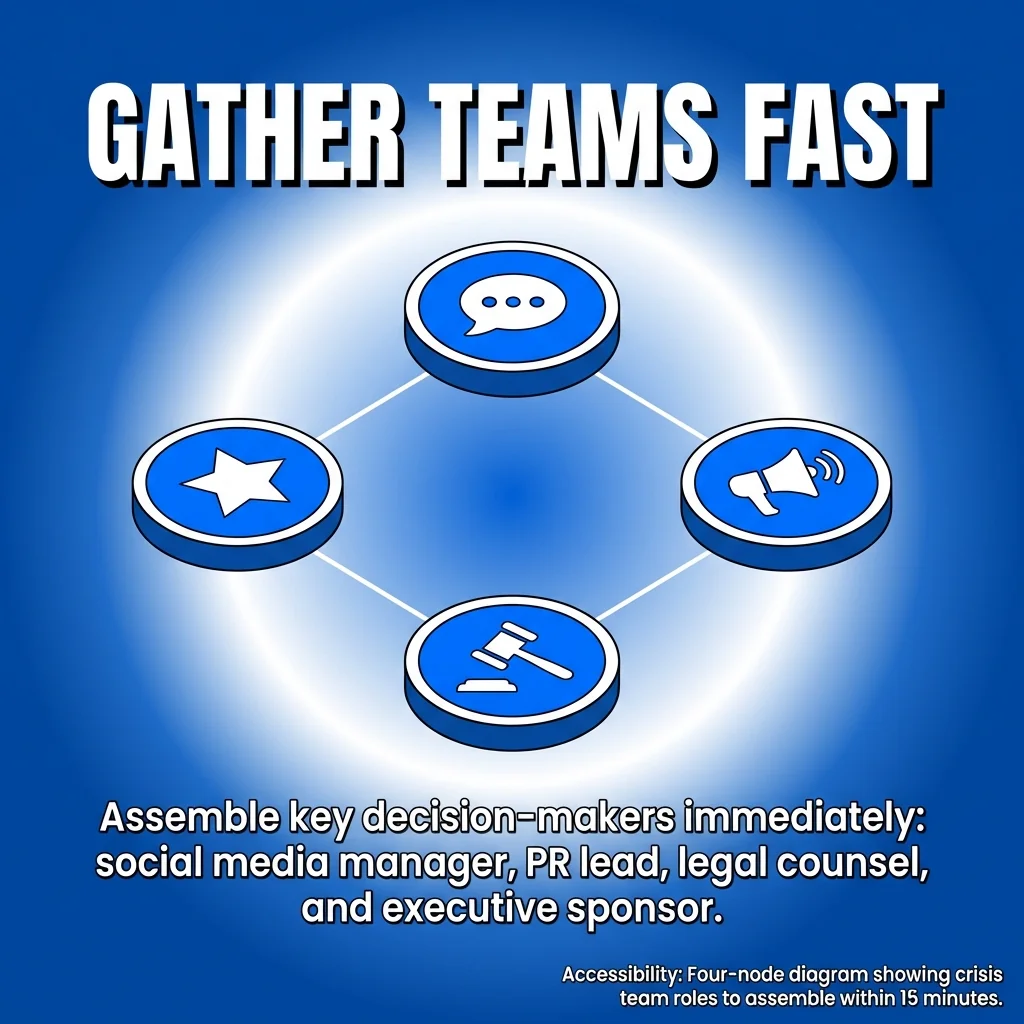
Your social media manager provides real-time sentiment data and platform-specific context. Legal counsel identifies potential liability issues that might constrain your response options. PR leadership evaluates broader reputation implications and stakeholder concerns. The executive sponsor ensures sufficient resources and authority for rapid decision-making.
Use a dedicated communication channel for crisis coordination. Slack channels or group messaging apps work better than email threads because they enable instant collaboration without inbox delays.
Document Everything From the Start
Screenshot the original post, all comments, shares, and media coverage before anything gets deleted or edited. This documentation protects your organisation legally and provides accurate reference material for crafting your response.
Track timestamps for every development. When did you first notice the issue? When did negative sentiment spike? When did media outlets pick up the story? This timeline becomes crucial for understanding escalation patterns and demonstrating response speed to stakeholders.
Create a shared document where team members log developments in real time. Include sentiment summaries, key influencer responses, media inquiries, and internal decisions. This centralised record prevents miscommunication and ensures everyone works from the same information.
Evaluate the Damage Scope
Quantify the situation using specific metrics rather than subjective impressions. How many people have seen the problematic post? What’s the negative-to-positive sentiment ratio in comments and shares? Are influencers or media outlets amplifying the issue?
Check whether the mistake has spread beyond your immediate followers. Search Twitter, news sites, and industry forums for mentions of your brand name alongside the controversy. Wider spread indicates higher severity requiring more comprehensive response approaches.
Assess whether the mistake touches sensitive topics that amplify emotional responses. Posts involving social justice issues, political topics, or personal tragedies generate more intense reactions than purely commercial missteps. Adjust your crisis response intensity accordingly.
Step 2: Decide Whether to Delete the Post
The delete-or-keep decision carries significant consequences either way. Deleting can appear evasive whilst keeping it up might suggest you’re not taking the situation seriously. Strategic thinking, not panic, should drive this choice.
Delete the post immediately if it contains false information, violates platform policies, includes offensive slurs, or exposes confidential data. These situations require removal regardless of transparency concerns because the content itself causes ongoing harm every moment it remains visible.
Keep the post up but add context through comments or updates when the mistake involves tone, timing, or misunderstanding rather than inherently harmful content. This approach demonstrates accountability whilst preserving the full record of what happened and how you responded.
Consider your audience’s expectations around transparency. Highly engaged communities that value authenticity often prefer seeing mistakes acknowledged in place rather than deleted without explanation. Corporate audiences may expect swift removal followed by official statements through proper channels.
The Transparency Test
If you delete the post, you must acknowledge the deletion explicitly in your follow-up communication. Trying to quietly remove content whilst hoping nobody noticed invariably backfires when screenshots already circulate widely. The cover-up always causes more damage than the original mistake.
Post an immediate explanation when you delete content: “We removed our earlier post about [topic] because [specific reason]. We apologise for [specific harm caused] and are taking [specific corrective action].” This demonstrates accountability whilst preventing speculation about your motives.
For serious social media disasters, consider replacing the deleted post with your apology response in the same location. This maintains transparency by showing where the mistake occurred whilst demonstrating swift corrective action. Your social media marketing strategy should include protocols for handling these decisions quickly.
Platform-Specific Considerations
Different platforms handle deletions differently. Twitter’s fast-moving timeline means deleted tweets often disappear from most users’ feeds quickly, whilst deleted Facebook posts in community groups remain visible as “post removed” placeholders that draw more attention to the deletion.
Instagram Stories auto-delete after 24 hours anyway, so removing them early might seem like attempted erasure. LinkedIn’s professional context means mistakes can damage corporate reputation more severely, often warranting faster removal followed by formal statements.
YouTube videos require careful consideration because removing content with significant views creates a visibility gap that prompts questions. Consider unlisting the video rather than deleting it outright, then posting a follow-up video addressing the situation directly.
Step 3: Respond Quickly and Sincerely
Silence after a social media disaster creates information vacuums that critics fill with speculation and conspiracy theories. Your response speed demonstrates how seriously you take the situation and signals respect for affected stakeholders.
Aim for initial response within one hour of identifying the problem. This doesn’t mean you need all the answers immediately, but you must acknowledge the situation and commit to transparent follow-up with specific timelines.
Craft a Message That Sounds Human
Avoid corporate-speak and legal jargon that distances your brand from genuine accountability. “We apologise for any offence caused” sounds defensive and insincere. “We made a serious mistake and we’re deeply sorry for the harm caused” demonstrates actual remorse and ownership.
Use first person pronouns when appropriate. “I made an error in judgment” from the responsible team member carries more authenticity than “Mistakes were made” passive voice constructions. People respond to human accountability, not institutional deflection.
Address specific harm your mistake caused rather than issuing generic apologies. If your post trivialised mental health struggles, name that harm explicitly. If it perpetuated racial stereotypes, acknowledge that specific impact. Precision signals genuine understanding of what went wrong.
Your brand voice consistency matters even in crisis moments. Don’t abandon your established communication style completely, but adapt it to show appropriate seriousness whilst maintaining authenticity.
Choose the Right Communication Channel
Respond on the same platform where the mistake occurred whenever possible. If Twitter users saw the problematic post, they need to see your apology on Twitter. Cross-platform responses create fragmentation where parts of your audience miss crucial information.
For severe reputation crises that generate media coverage, supplement social media responses with official statements on your website, email to key stakeholders, and direct outreach to affected parties. Multi-channel communication ensures your response reaches everyone who needs to see it.
Consider video responses for particularly serious situations. Seeing a real person speak directly to the camera conveys sincerity more effectively than text statements. The executive sponsor or responsible team member should deliver this message, demonstrating that senior leadership takes the situation seriously.
Set Clear Expectations for Next Steps
Your initial response should include specific commitments with realistic timelines. “We will provide a full update by [specific date and time]” gives your audience a concrete expectation whilst buying you time for thorough investigation and planning.
Don’t promise actions you can’t deliver. Vague commitments to “do better” or “review our processes” sound hollow without specific measures. Detail exactly what will change: employee training programmes, revised approval processes, or policy updates.
Assign a spokesperson for ongoing updates. Consistency in communication builds trust during recovery. Designate one person to handle public responses whilst the broader team works on corrective actions behind the scenes.
Step 4: Own Your Mistake Without Excuses
Deflection, blame-shifting, and excuse-making transform recoverable social media mistakes into protracted reputation crises. Complete ownership, even when it feels uncomfortable, accelerates trust rebuilding and demonstrates mature leadership.
Take full responsibility without qualifying statements that undermine accountability. “We’re sorry, but we didn’t intend offence” immediately negates your apology by introducing defensive justification. “We’re sorry. We caused harm. Here’s how we’re fixing it” demonstrates genuine accountability.
Avoid These Common Excuse Patterns
Don’t blame individual employees publicly when organisational systems failed. “A rogue employee posted without approval” suggests you’re throwing someone under the bus rather than examining why approval processes allowed the mistake. Fix the system, don’t scapegoat individuals externally.
Don’t cite automation or technical errors unless they genuinely explain what happened. “Our scheduling tool posted at the wrong time” might be factually true but sounds like you’re deflecting responsibility for inadequate oversight of automated systems.
Don’t invoke misunderstanding as an excuse. “People misinterpreted our intent” places blame on your audience rather than acknowledging your communication failed. If people misunderstood your message, your message was unclear. Own that communication failure completely.
Avoid political or social commentary that wasn’t part of your original mistake. Don’t use your apology as an opportunity to stake out positions on controversial topics unless the mistake directly involved those topics. Stay focused on addressing the specific harm caused.
Demonstrate Understanding of Why It Matters
Explain what you learned from the mistake in specific terms. “We now understand how our language perpetuated harmful stereotypes” shows you’ve reflected deeply on the impact. “We didn’t realise people would be upset” suggests you still don’t grasp why the mistake mattered.
Connect the mistake to broader values and commitments. “This contradicts our stated commitment to inclusive marketing” demonstrates you understand the inconsistency between your actions and principles. This acknowledgment strengthens rather than weakens your position because it shows self-awareness.
Reference affected communities directly when appropriate. If your mistake harmed a specific group, address them explicitly in your apology. “To the LGBTQ+ community we offended…” demonstrates you recognise who bears the actual impact of your error.
Understanding sentiment analysis for crisis management helps you gauge whether your ownership message resonates authentically with affected audiences or sounds like empty corporate speak.
Step 5: Monitor and Engage With All Mentions
Crisis response doesn’t end when you post your apology. Active monitoring and thoughtful engagement determine whether your recovery gains traction or stalls whilst negative sentiment continues spreading unchecked.
Set up comprehensive monitoring across all platforms where your audience might discuss the situation. This includes your own social channels, industry forums, news sites, and third-party review platforms. Use social listening tools to catch mentions that don’t directly tag your accounts.
Deploy Social Listening Tools Strategically
Mention and Brandwatch provide real-time alerts when your brand appears in social conversations anywhere online. Configure alerts for common misspellings and related hashtags that critics might use to discuss your mistake without directly tagging you.
Track sentiment trends rather than individual comments. Is overall sentiment improving, stabilising, or continuing to deteriorate? Sentiment trajectory tells you whether your response is working or whether you need to adjust your approach.
Monitor influencer responses particularly closely. When industry leaders or high-follower accounts comment on your situation, their perspectives shape broader audience reactions. Engage thoughtfully with influencer commentary when appropriate, avoiding defensive postures that might escalate tensions.
Your sentiment analysis approach should identify both direct criticism and more subtle indicators of audience mood shifts that might signal developing issues before they escalate.
Respond to Comments Constructively
Engage genuinely with legitimate criticism whilst avoiding feeding trolls who seek attention rather than resolution. This distinction requires judgment but generally: respond to specific concerns about your mistake, ignore name-calling and abuse that seeks reactions rather than accountability.
Personalise responses rather than copying the same apology repeatedly. Acknowledge specific points critics raise and explain how your corrective actions address their particular concerns. This demonstrates you’re listening rather than managing.
Accept that some people won’t accept your apology immediately or ever. Don’t argue with critics who remain unconvinced. Respond once with sincere acknowledgment, then redirect your energy toward demonstrating changed behaviour over time rather than winning every argument.
Thank people who acknowledge your apology or support your corrective actions. Positive reinforcement of constructive dialogue encourages more balanced conversation rather than allowing the discussion to remain entirely focused on criticism.
Create a Response Protocol for Your Team
Designate specific team members to handle different response categories. One person manages media inquiries, another handles customer service concerns, a third engages with industry peers. This prevents duplicated effort and ensures consistent messaging.
Establish escalation criteria for responses that require senior leadership attention. Comments from major customers, regulators, or media outlets should get faster, higher-level responses than typical audience feedback.
Document common questions and create approved response templates that team members can personalise. This balances efficiency with authenticity by giving responders a starting framework that they adapt to specific situations rather than sending identical replies.
Step 6: Rebuild Trust Through Consistent Action
Words apologise, but actions rebuild trust. Your response after the initial apology determines whether stakeholders believe your commitment to change or view your statements as empty crisis management theatre.
Execute the specific commitments you made in your initial response exactly as promised. If you said you’d implement new approval processes within 30 days, communicate publicly when those processes launch. Following through demonstrates reliability when your reputation needs it most.
Make Changes Visible
Share concrete evidence of corrective actions publicly. Post photos of employee training sessions you promised. Publish updated social media policies that address the gap your mistake revealed. Announce partnerships with organisations that represent communities your mistake harmed.
Create content that demonstrates applied learning from the mistake. If your error involved cultural insensitivity, publish thoughtful content that shows deeper understanding of those communities. If it involved misinformation, share well-researched factual content that corrects the record.
Invite external accountability through advisory relationships or oversight mechanisms. Partner with advocacy organisations relevant to your mistake. Create advisory boards including representatives from affected communities. These relationships signal genuine commitment beyond one-time apologies.
Your social media strategy going forward should incorporate lessons learned from the crisis, demonstrating that the mistake produced meaningful organisational growth rather than just temporary embarrassment.
Encourage Positive Engagement Strategically
Gradually shift conversation toward positive brand activities without appearing to bury the mistake under promotional content. Wait until negative sentiment substantially decreases before ramping up normal marketing activities, otherwise you’ll appear tone-deaf and reignite criticism.
Encourage satisfied customers to share positive experiences naturally rather than soliciting reviews that look like reputation manipulation. Successful campaigns during recovery focus on genuine value delivery rather than image management.
Highlight employee voices and behind-the-scenes content that humanises your organisation. When audiences see real people working hard to improve, they’re more likely to grant second chances than when they only interact with polished corporate messaging.
Measure Recovery Progress
Track specific metrics that indicate trust rebuilding: sentiment ratios improving, engagement rates returning to baseline, customer retention stabilising, media coverage becoming more balanced or positive.
Set realistic recovery timelines based on mistake severity. Minor social media mistakes might recover within days whilst major reputation crises can require months of consistent positive action before trust fully restores.
Report progress transparently to stakeholders. Share quarterly updates showing metrics that demonstrate recovery: improved customer satisfaction scores, successful implementation of promised changes, or positive feedback from affected communities.
How to Prevent Future Social Media Disasters
Recovery teaches valuable lessons, but prevention eliminates the need for crisis management entirely. Systematic safeguards reduce social media mistake frequency whilst building organisational resilience for inevitable occasional errors.
Implement multi-stage approval processes for sensitive content categories. Posts touching political topics, social issues, or trending hashtags should require review from multiple perspectives before publishing. This catches potential problems before they reach your audience.
Build a Crisis-Ready Team
Train employees regularly on social media best practices and crisis response protocols. Run tabletop exercises where teams practice responding to hypothetical social media disasters. This preparation reduces panic and improves coordination when real crises emerge.
Create clear escalation paths so team members know exactly who to contact when they spot potential problems. Ambiguity in crisis response chains delays critical decisions that determine recovery success.
Develop comprehensive social media policies that address common mistake categories: what topics to avoid, how to discuss sensitive issues, when to engage versus ignore criticism, and approval requirements for different content types. Make these policies living documents that evolve based on emerging platform trends and lessons learned.
Your social media management efficiency improves when clear policies eliminate ambiguity and speed appropriate decision-making without sacrificing safety.
Use Technology to Reduce Human Error
Implement Sprout Social or Hootsuite for scheduled content management. These platforms provide safety features like approval workflows, scheduled post previews, and platform-specific formatting checks that catch errors before publishing.
Enable two-factor authentication on all social media accounts to prevent unauthorised access. Account hijacking creates social media disasters that damage brand reputation whilst eliminating your control over the narrative.
Set up keyword filters that flag potentially problematic content for additional review before posting. Configure alerts for sensitive terms related to protected characteristics, controversial topics, or common offensive language patterns.
Foster a Culture of Thoughtful Communication
Encourage team members to pause before posting content that might generate strong reactions. Create a “wait 30 minutes” rule for reactive posts responding to news events or trending topics. This cooling-off period prevents impulsive mistakes driven by real-time social media pressure.
Celebrate team members who raise concerns about potentially problematic content. When employees feel comfortable questioning posts without fear of being labelled difficult or negative, they catch mistakes before they become public disasters.
Regular content audits help identify patterns in near-misses: posts that almost caused problems but got caught before publishing. These patterns reveal systemic gaps in training, approval processes, or policy coverage that need addressing before luck runs out.
Stay Current on Platform Changes and Social Trends
Assign team members to monitor emerging social movements, evolving language norms, and shifting audience expectations around brand behaviour. What seemed acceptable five years ago might cause backlash today. Staying informed prevents tone-deaf mistakes.
Subscribe to crisis management resources and public relations publications that analyse high-profile social media disasters. Learning from other brands’ mistakes costs nothing whilst providing valuable case studies for your team’s training.
Build relationships with community leaders and advocacy organisations before you need them during crises. These connections provide valuable perspective on whether planned content might cause unintended harm to specific communities.
Learning from common content mistakes across channels helps prevent similar errors in your social media execution.
Moving Forward With Confidence
Social media mistakes happen to every brand eventually. Perfect prevention remains impossible when humans manage real-time communication across multiple platforms simultaneously. What separates successful brands from damaged ones isn’t avoiding mistakes entirely but responding to them with speed, sincerity, and substantive corrective action.
The framework outlined here provides clear crisis response steps that protect your brand reputation whilst demonstrating genuine accountability. When you respond within one hour, take complete ownership, engage thoughtfully with criticism, and follow through on specific commitments, you transform potential disasters into opportunities for deeper stakeholder trust.
Start implementing prevention strategies today, before the next crisis emerges. Build approval processes, train your team, and create crisis communication plans whilst you have time for thoughtful planning rather than emergency reaction. The best crisis response begins long before mistakes occur.
Your social media presence strengthens when you demonstrate both competence and humility. Acknowledge that mistakes will happen, prepare systematic responses, and commit to learning from every error. This approach builds resilient brand reputation that withstands inevitable occasional social media disasters whilst maintaining authentic connections with your audience.