Social media transforms product launches from isolated announcements into shared experiences that build momentum across weeks. Successful product launch social media plans begin with clear SMART goals, such as increasing page followers from 200 to 1,000 by a set deadline. This structured approach ensures every post, teaser, and engagement tactic aligns with measurable business objectives rather than scattering efforts across disconnected activities.
The difference between launches that generate buzz and those that fall flat often comes down to strategic planning. Social platforms offer unmatched reach and engagement potential when marketers coordinate content across pre-launch, launch day, and post-launch phases with intentional timing and messaging.
This guide walks through the complete planning process for product launch social media campaigns. You’ll learn how to set goals that drive real business outcomes, choose platforms that match your target audience, build anticipation with strategic teaser content, and execute coordinated launch day tactics that maximise visibility and engagement.
Why Social Media Planning Determines Product Launch Success
Product launches succeed or fail based on visibility and engagement during critical launch windows. Social media platforms provide the reach and interaction mechanisms that traditional marketing channels cannot match.
Strategic social media planning creates three distinct advantages. First, coordinated campaigns build anticipation over weeks rather than relying on single-day announcements. Second, platform algorithms reward consistent posting schedules and high engagement rates with increased organic reach. Third, social channels enable real-time feedback collection that informs product messaging and positioning adjustments.
Without structured planning, product launches become reactive rather than strategic. Teams post sporadically, miss optimal timing windows, and fail to coordinate messaging across platforms. Setting effective social media goals prevents this scattered approach by establishing clear metrics and timelines.
The planning framework outlined in this guide ensures launches follow proven patterns. You’ll establish goals first, then build content calendars and platform strategies that support those objectives with specific, measurable tactics.
Establishing Clear Goals and Success Metrics
Product launch social media goals must connect directly to business outcomes. Vanity metrics like follower counts matter less than engagement rates, conversion actions, and measurable ROI.
Defining SMART Goals for Launch Campaigns
SMART goals transform vague aspirations into actionable targets. Specific goals identify exact outcomes. Measurable goals include quantifiable metrics. Achievable goals reflect realistic resource constraints. Relevant goals align with broader business objectives. Time-bound goals establish clear deadlines.
Example SMART goals for product launches include increasing Instagram followers by 500 within four weeks, generating 200 pre-launch email signups through social campaigns, or achieving 10,000 launch day post impressions across platforms.
These concrete targets guide content creation and platform selection decisions. When evaluating whether to invest in TikTok videos or LinkedIn articles, reference your established goals to determine which format best supports your objectives.
Selecting Key Performance Indicators
KPIs translate goals into trackable metrics. Common product launch KPIs include engagement rate, click-through rate to product pages, conversion rate from social traffic, share rate, and hashtag performance.
Track KPIs throughout the launch timeline rather than waiting until launch day. Pre-launch metrics indicate whether teaser campaigns build sufficient anticipation. Launch day metrics show immediate response. Post-launch metrics reveal sustained interest and long-term engagement patterns.
| Launch Phase | Primary KPIs | Measurement Focus |
|---|---|---|
| Pre-Launch | Teaser engagement rate, email signups | Anticipation building effectiveness |
| Launch Day | Post impressions, click-through rate, shares | Immediate visibility and interest |
| Post-Launch | Conversion rate, sustained engagement, UGC volume | Long-term interest and advocacy |
Established metrics create accountability and enable real-time strategy adjustments. Measuring social media ROI becomes straightforward when you’ve defined success criteria from the start.
Conducting Pre-Launch Research and Audience Analysis
Start by auditing your current social media status, including platforms, audience demographics, follower counts, engagement rates, and post reach. This baseline data reveals which channels already perform well and which require strategic investment.
Analysing Platform Performance
Review analytics from existing social channels to identify patterns. Which content formats generate highest engagement? What posting times correlate with peak reach? Which audience segments interact most frequently?
Platform analytics tools provide this data. Instagram Insights shows follower demographics and post performance. Facebook Analytics reveals audience behaviour patterns. LinkedIn Analytics displays professional demographic information. TikTok Analytics tracks video view patterns and audience retention rates.
Use these insights to inform platform selection and content strategy decisions. If Instagram Stories consistently outperform feed posts, prioritise story-based teaser campaigns. If LinkedIn articles generate qualified leads whilst Facebook posts drive casual engagement, allocate resources accordingly.
Researching Target Audience and Market Position
Conduct market research through surveys, interviews, and competitor analysis to identify customer pain points and underserved needs. This research reveals where your product fits within existing market conversations and which messaging angles resonate most strongly.
Survey existing customers about their social media habits. Which platforms do they use daily? What content formats do they prefer? Which influencers do they follow? These insights shape platform selection and content creation priorities.
Analyse competitor product launches to identify successful tactics and missed opportunities. Note which platforms competitors prioritise, what content formats they use, and how audiences respond. Adapt successful patterns whilst avoiding strategies that generated minimal engagement.
Selecting Social Media Platforms Based on Product and Audience
Platform selection determines content format requirements, audience reach potential, and resource allocation priorities. Each platform serves distinct audience segments and supports different content types.
Matching Platforms to Target Audiences
Instagram works well for visual products targeting consumers aged 18-45. TikTok reaches younger audiences with short-form video content. Facebook provides broad reach across age groups with diverse content formats. LinkedIn targets professionals and B2B audiences. Twitter enables real-time conversations and trending topic participation.
Select platforms based on where your target audience already spends time. B2B software products typically prioritise LinkedIn and Twitter. Consumer goods often focus on Instagram and TikTok. Professional services might emphasise LinkedIn whilst also maintaining Facebook presence for community building.
Most successful product launches focus on 2-3 primary platforms rather than attempting presence across all channels. This focused approach enables higher-quality content and more consistent engagement.
Evaluating Platform-Specific Content Requirements
Each platform demands distinct content formats and posting patterns. Instagram requires high-quality images and short videos. TikTok needs entertaining short-form videos with trending audio. LinkedIn favours longer-form articles and professional imagery. Facebook supports diverse formats including text posts, images, videos, and live streams.
Assess your content creation capabilities against platform requirements. Can your team produce daily TikTok videos? Do you have professional imagery for Instagram? Can you write engaging LinkedIn articles? Platform selection must align with realistic content production capacity.
| Platform | Ideal Content Formats | Launch Applications |
|---|---|---|
| Stories, Reels, carousel posts | Visual teasers, countdown posts, product reveals | |
| TikTok | Short-form videos with trending audio | Behind-the-scenes content, creative reveals, challenges |
| Articles, professional images, company updates | Thought leadership, B2B announcements, professional networking | |
| Mixed media posts, events, live videos | Community building, event promotion, broad announcements |
Building Your Pre-Launch Content Calendar and Timeline
Content calendars transform launch strategies into scheduled actions. They establish posting frequency, coordinate messaging across platforms, and ensure consistent communication during critical launch phases.
Establishing Pre-Launch Timeline
Begin pre-launch social media activity 4-6 weeks before launch day for significant products. Smaller launches may compress this timeline to 2-3 weeks. Longer timelines enable gradual anticipation building whilst maintaining audience interest without fatigue.
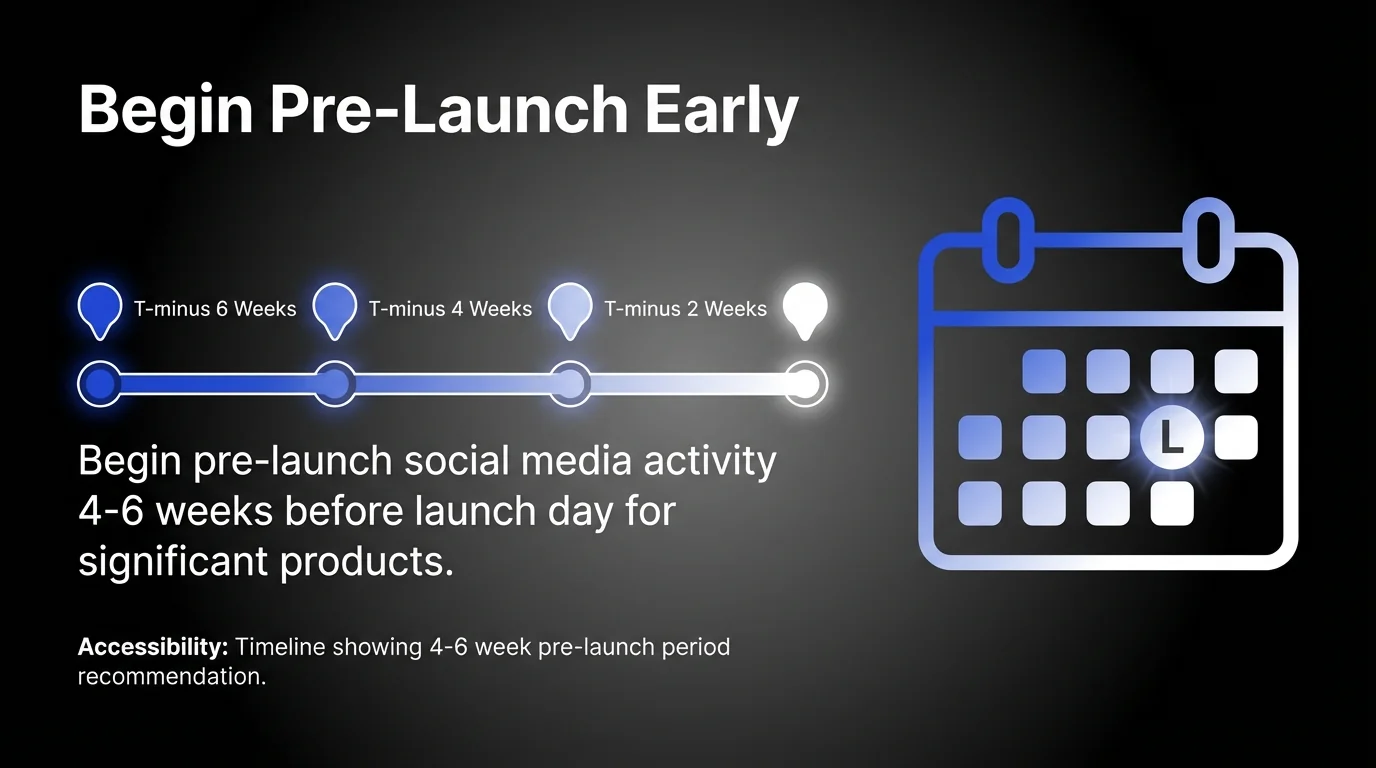
Divide the pre-launch period into phases. Early weeks focus on problem awareness and subtle product hints. Middle weeks introduce more direct product teasers and behind-the-scenes content. Final weeks before launch intensify with countdown posts and concrete reveal details.
Creating a social media content calendar requires mapping specific post types to each phase. Document what you’ll post, when you’ll post it, which platforms receive each piece of content, and who’s responsible for creation and publishing.
Coordinating Content Across Platforms
Cross-platform coordination ensures consistent messaging whilst respecting platform-specific format requirements. A single product teaser might become an Instagram Story, a TikTok video, a LinkedIn text post, and a Facebook image post with adapted copy and format for each channel.
Schedule posts strategically across platforms rather than publishing identical content simultaneously. Stagger posting times to maximise total reach. If your audience engages most with Instagram at 10am and LinkedIn at 2pm, schedule platform-specific posts for those windows.
Content calendar tools like Buffer, Hootsuite, or Sprout Social centralise scheduling and enable team collaboration. Download a social media content calendar template to streamline this planning process.
Creating Teaser Content That Builds Anticipation
Social media campaigns commonly use teaser content to build anticipation, with contests boosting engagement through participation and shares. Strategic teasers generate curiosity without revealing complete product details too early.
Designing Effective Teaser Post Types
Behind-the-scenes content shows product development progress without full reveals. Share design process images, team photos, or manufacturing glimpses that hint at the final product.
Problem-focused posts highlight customer pain points your product solves. These establish relevance and need without mentioning the product directly. Follow-up posts then position your launch as the solution.
Countdown posts create urgency and mark time until launch day. Use countdown graphics, numbered daily posts, or platform-specific countdown stickers on Instagram Stories.
Sneak peek posts reveal partial product features or packaging details. Show product silhouettes, close-up texture shots, or isolated feature demonstrations that intrigue without complete disclosure.
Leveraging User-Generated Content and Early Advocates
Identify early advocates who can create authentic teaser content. These might include beta users, industry partners, or community members excited about your product category.
Provide early advocates with preview access or exclusive information they can share with their audiences. Their third-party endorsements carry more weight than brand-created content alone.
Create branded hashtags that early advocates and interested community members can use. Monitor these hashtags to identify user-generated content worth amplifying through your official channels.
Contests and giveaways incentivise engagement and content creation. Ask followers to share why they’re excited about the launch, tag friends who’d benefit from the product, or create content using your branded hashtag for entry.
Developing Influencer Partnerships for Extended Reach
Influencer collaborations extend launch reach beyond your existing follower base. Strategic partnerships connect your product with established audiences who trust influencer recommendations.
Identifying Relevant Influencers
Relevant influencers serve audiences that match your target customer demographics. Analyse influencer follower demographics, engagement rates, and content themes to ensure alignment.
Micro-influencers with 10,000-100,000 followers often deliver better engagement rates and audience trust than macro-influencers despite smaller reach. Their audiences view them as authentic experts rather than paid endorsers.
Evaluate influencer authenticity by reviewing their past sponsored content. Do they only promote products they genuinely use? Do their followers engage positively with sponsored posts? Have they worked with competitors, and if so, what were the results?
Structuring Influencer Collaborations
Provide influencers with early product access so they can create authentic content based on genuine product experience. Scripted endorsements appear less credible than organic reviews.
Establish clear expectations regarding posting requirements, content format, and key messaging points. Specify how many posts influencers should create, which platforms to use, and which product features to highlight.
Coordinate influencer posting schedules with your overall launch timeline. Some influencers should post teasers during pre-launch phases. Others should publish detailed reviews on launch day. Additional influencers might create follow-up content during post-launch weeks.
Successful social media campaigns often combine owned content, influencer partnerships, and paid amplification to maximise reach across audience segments.
Executing Your Launch Day Social Media Strategy
Launch day execution requires coordinated posting, real-time monitoring, and rapid response capabilities. This concentrated activity maximises visibility during the critical launch window.
Coordinating Launch Day Posts
Schedule primary launch announcements for each platform’s peak engagement times. Post the main announcement early enough for followers in multiple time zones to see it during active hours.
Create platform-specific variations of your launch announcement. Instagram might feature a carousel post showing product images and key features. LinkedIn might include a longer-form article explaining product development and business applications. TikTok might showcase a creative product demonstration video.
Follow initial announcements with supplementary posts throughout the day. Share customer testimonials, highlight specific features, answer common questions, and repost user-generated content from early customers.
Monitoring and Engaging in Real-Time
Assign team members to monitor social channels continuously throughout launch day. Respond to comments, answer questions, and engage with user posts mentioning your product or branded hashtags.
Rapid response demonstrates commitment to customer engagement and builds positive sentiment. When someone asks about product specifications, shipping details, or pricing, immediate answers convert interest into purchases.
Track launch day performance metrics hourly. Monitor post reach, engagement rates, click-through rates to product pages, and conversion data. These metrics reveal whether launch day tactics achieve established goals.
Prepare to adjust strategy based on real-time data. If certain post types generate exceptional engagement, create more similar content immediately. If specific platforms underperform expectations, shift resources to higher-performing channels.
Managing Post-Launch Engagement and Community Building
Post-launch social media activity sustains momentum and converts initial interest into long-term customer relationships. Consistent engagement prevents the energy drop that often follows launch day.
Maintaining Content Momentum
Continue regular posting after launch day with educational content, user testimonials, and feature spotlights. Shift from announcement-focused content to value-driven content that helps customers maximise product benefits.
Share customer success stories and use cases that demonstrate real-world applications. User-generated content showing customers using your product provides authentic social proof more compelling than brand-created marketing.
Address common questions and feedback through dedicated posts. If multiple customers ask about the same feature, create detailed content explaining that functionality. If concerns emerge about specific aspects, acknowledge them transparently and explain how you’re addressing them.
Collecting and Responding to Customer Feedback
Monitor social mentions, comments, and direct messages for customer feedback. Both positive and negative feedback provides valuable insights into product performance and customer satisfaction.
Respond to negative feedback promptly and professionally. Public responses to complaints demonstrate customer service commitment to broader audiences beyond the individual customer raising concerns.
Use feedback to inform product iterations and future marketing messaging. If customers consistently praise specific features, highlight those in ongoing social content. If they identify confusing aspects, create educational content addressing those points.
Unlocking social media engagement requires treating social channels as conversation spaces rather than broadcast platforms. Active listening and genuine interaction build communities around products.
Analysing Performance and Optimising Future Launches
Post-launch analysis transforms launch experience into actionable insights. Systematic evaluation identifies successful tactics worth repeating and underperforming strategies requiring adjustment.
Measuring Results Against Established Goals
Compare actual performance metrics against the SMART goals established during planning phases. Did you achieve your follower growth target? Did engagement rates meet expectations? Did social traffic convert at projected rates?
Analyse performance differences across platforms. Which channels exceeded expectations? Which underperformed? Platform-specific insights guide future resource allocation decisions.
Calculate return on investment for paid social campaigns and influencer partnerships. Determine which promotional investments generated positive ROI and which consumed resources without proportional returns.
Documenting Lessons and Recommendations
Create comprehensive launch reports documenting strategies, tactics, results, and insights. Include what worked well, what underperformed, and specific recommendations for future product launches.
Identify content types that generated highest engagement. Note which post formats, messaging angles, and creative approaches resonated most strongly with target audiences.
Document operational insights about team coordination, content production workflows, and approval processes. Smooth operations enable better execution, whilst bottlenecks and delays diminish campaign effectiveness.
Share findings with broader marketing teams so insights inform future campaigns beyond product launches. Successful social tactics often apply to ongoing content strategies, not just launch-specific campaigns.
Moving Forward With Strategic Social Media Planning
Product launch social media success stems from structured planning that coordinates content, timing, and engagement tactics across platforms. The framework outlined here provides a systematic approach applicable to launches of any scale.
Begin your next product launch by establishing clear SMART goals that connect social media activities to business outcomes. Build content calendars that coordinate teaser content, launch day posts, and post-launch engagement across 4-6 week timelines.
Select platforms based on where your target audience actively engages rather than attempting presence across all channels. Focus resources on 2-3 primary platforms where you can maintain consistent, high-quality content.
The most successful product launches treat social media as conversation spaces that build anticipation, enable real-time engagement, and foster ongoing community relationships. Use sentiment analysis to track how audiences respond to your messaging throughout launch phases.
Start planning your next product launch social media strategy today. Audit your current social presence, define measurable goals, and build the content calendar that will transform your launch from a single announcement into a coordinated campaign that generates lasting momentum.