
Social media has transformed how brands communicate. Your voice needs consistency across every platform.
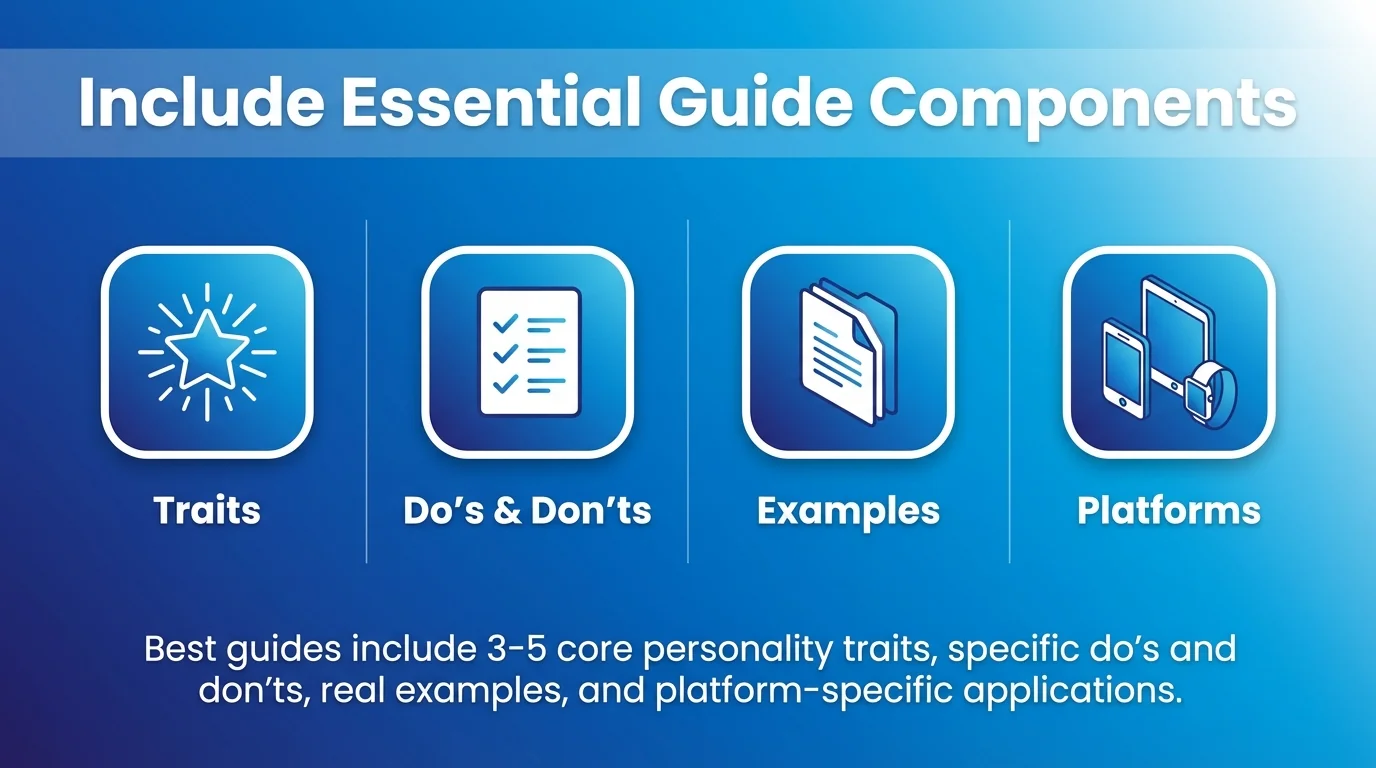
A brand voice guide defines your personality, tone, and style across all touchpoints. It ensures every team member speaks with one authentic voice, building recognition and trust. The best guides include 3-5 core personality traits, specific do’s and don’ts, real examples, and platform-specific applications that maintain consistency whilst adapting to each channel’s unique context.
Creating a solid brand voice guide transforms scattered messaging into cohesive communication. Your audience will recognise your content instantly, whether they see it on Instagram, LinkedIn, or Twitter.
What Is Brand Voice? Understanding the Foundation
Brand voice represents the consistent personality your business expresses through all communication. It’s how you sound, not what you say.
Think of brand voice as your company’s character. It reflects your mission, values, and identity in every piece of content you create.
A strong brand voice builds recognition, trust, and emotional connections with audiences on social media. When done well, it makes your content instantly recognisable.
Your brand voice stays consistent. A friendly, approachable voice remains friendly whether you’re posting on social media, writing emails, or creating website content.
The Core Elements of Brand Voice
Brand voice comprises several key components that work together:
- Personality traits that define your character
- Language style and vocabulary choices
- Values and mission alignment
- Communication patterns and messaging approach
- Emotional resonance with your target audience
These elements combine to create authentic communication. Your brand personality might be confident, friendly, educational, or bold.
The language you choose reflects these traits. A playful brand uses different vocabulary than a serious, professional one.
Why Brand Voice Matters for Your Business
Brand voice creates consistency across all channels and platforms. It ensures your Instagram posts sound like they come from the same company as your LinkedIn articles.
This consistency builds trust. Customers learn to recognise your authentic communication style and feel more connected to your brand identity.
Developing a clear brand voice helps teams collaborate more effectively. Everyone understands how to represent your brand in their content.
Brand Voice vs Brand Tone: Clarifying the Distinction
Many marketers confuse brand voice and tone. They’re related but distinctly different concepts.
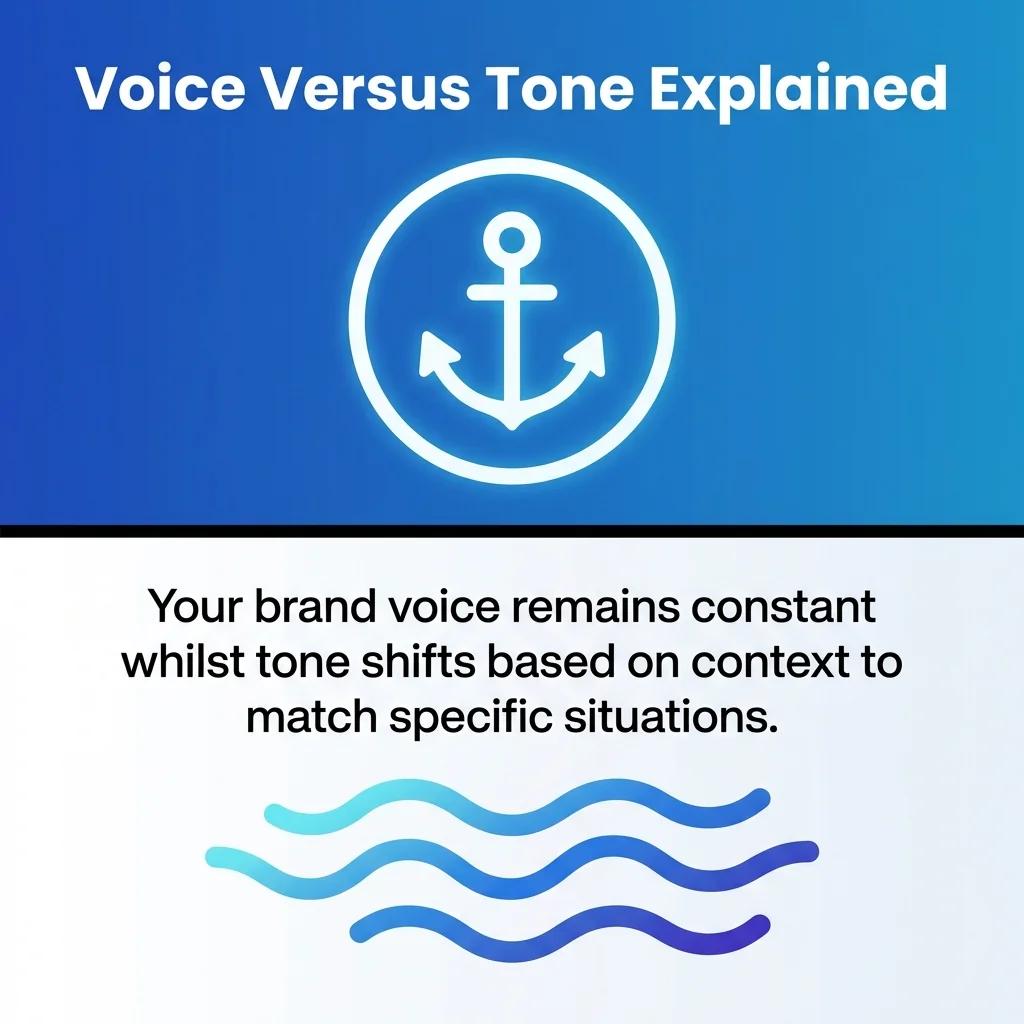
Your brand voice remains constant. It’s your personality, unchanging across all situations and contexts.
Tone shifts based on context. It’s how you adjust your voice for different situations whilst maintaining your core personality.
Understanding Voice Consistency
Brand voice is your fixed personality. Whether you’re celebrating success or addressing complaints, your underlying character stays the same.
A friendly brand maintains friendliness in every scenario. The warmth remains constant even when topics change.
This consistency makes your brand recognisable. Followers know what to expect from your communication style.
How Tone Adapts While Voice Remains
Tone adjusts to fit specific situations. A playful brand might use an enthusiastic tone for product launches but a more subdued tone for customer service.
The voice stays playful. The tone simply modulates that playfulness appropriately.
Think of voice as your personality and tone as your mood. Your personality doesn’t change, but your mood adapts to circumstances.
| Aspect | Brand Voice | Brand Tone |
|---|---|---|
| Consistency | Always the same | Changes by context |
| Application | All content and channels | Specific situations |
| Purpose | Define personality | Match the moment |
Effective brand communication requires both. Your voice provides consistency whilst your tone demonstrates emotional intelligence.
Why Brand Voice Guidelines Matter for Social Media Success
Social media demands consistency more than any other channel. Posts appear in crowded feeds where brand recognition happens instantly.
Strong brand voice guidelines ensure every post sounds authentic. Your team knows exactly how to represent your brand personality.
Without clear guidelines, content becomes inconsistent. Different team members interpret your brand differently, confusing your audience.
Building Recognition and Trust
Consistent brand voice creates immediate recognition. Followers spot your content before seeing your logo.
This recognition builds trust over time. Audiences appreciate knowing what to expect from your communication.
Maintaining consistency in brand voice becomes easier with documented guidelines. Teams reference specific examples rather than guessing.
Improving Team Collaboration and Efficiency
Brand voice guidelines streamline content creation. Writers spend less time wondering how to phrase things.
Approvals move faster when everyone understands the standards. Managers can quickly identify content that matches or misses the mark.
New team members onboard more effectively. They learn your brand personality through concrete examples and clear documentation.
Strengthening Brand Identity Across Platforms
Each social media platform has unique characteristics. Your brand voice adapts whilst maintaining core personality traits.
Guidelines show how your voice translates to different channels. Instagram might be more visual and casual, LinkedIn more professional, Twitter more concise.
The personality remains consistent. Only the application changes to fit platform conventions and audience expectations.
How to Create Your Brand Voice Guidelines: A Complete Framework
Creating effective brand voice guidelines requires systematic planning. You need research, definition, documentation, and application strategies.
This framework takes you through each essential step. The process ensures comprehensive, usable guidelines your team can actually implement.
Most businesses skip crucial steps. They jump to writing without adequate research or create vague guidelines without practical examples.
Overview of the Four-Step Process
The complete framework includes four distinct phases:
- Research your audience and define your mission
- Identify your brand personality traits and characteristics
- Document your brand voice guidelines and create your style guide
- Apply and adapt your voice across social media platforms
Each step builds on the previous one. Rushing through early stages creates weak foundations for later work.
Plan to spend adequate time on research and personality definition. These steps inform everything that follows.
Step 1: Research Your Audience and Define Your Mission
Understanding your audience shapes your entire brand voice. You’re speaking to real people with specific needs and preferences.
Start with audience research. Who are your customers? What language resonates with them?
Analyse demographics, psychographics, and communication preferences. Where do they spend time online? How do they talk about your industry?
Conducting Effective Audience Research
Examine your existing customer data. Look at social media followers, email subscribers, and customer profiles.
Read comments and messages. Notice the language customers use when they engage with your brand.
Survey your audience directly. Ask about their preferences, challenges, and how they like brands to communicate.
Study competitor audiences. What attracts people to similar brands? What communication styles succeed in your industry?
Connecting Voice to Mission and Values
Your brand mission defines your purpose. Your voice should communicate this purpose authentically.
List your core brand values. These principles guide how you communicate with your audience.
A sustainability-focused brand naturally adopts thoughtful, responsible language. A disruptive technology company might embrace bold, challenging communication.
Your mission and values create boundaries. They determine which personality traits fit and which don’t align with your identity.
Consistent brand messaging across platforms starts with clear mission alignment. Every message should reflect your core purpose.
Step 2: Identify Your Brand Personality Traits and Characteristics
Define 3-5 core personality traits such as confident, friendly, educational, or bold to guide messaging across channels. These traits become your brand’s character.

Choosing the right traits requires careful consideration. They must reflect your mission whilst appealing to your target audience.
Selecting Core Personality Traits
Start by brainstorming potential personality traits. Consider adjectives that describe how you want customers to perceive your brand.
Common brand personality traits include:
- Friendly and approachable
- Professional and authoritative
- Playful and humorous
- Bold and confident
- Educational and helpful
- Innovative and forward-thinking
Narrow your list to 3-5 core traits. Too many dilutes your personality. Too few limits your expressiveness.
Test combinations. Ensure your chosen traits complement rather than contradict each other.
Creating Personality Trait Definitions
Each trait needs clear definition. Generic labels like ‘friendly’ mean different things to different people.
Write specific descriptions for each personality trait. Explain exactly what ‘friendly’ means for your brand.
Include both positive expressions and boundaries. Show what the trait looks like and what goes too far.
| Personality Trait | Expression | Boundary |
|---|---|---|
| Friendly | Warm, welcoming language | Not overly casual or unprofessional |
| Bold | Confident, direct statements | Not aggressive or offensive |
| Educational | Helpful, informative content | Not condescending or preachy |
These definitions guide content creators. They understand not just the trait but how to express it appropriately.
Aligning Traits with Audience Expectations
Your personality traits should resonate with your target audience. They need to match customer preferences and industry context.
A playful personality works brilliantly for a snack brand. It might confuse customers of a legal services firm.
Test your personality traits against audience research. Do these characteristics appeal to your customers? Do they differentiate you from competitors?
Step 3: Document Your Brand Voice Guidelines and Style Guide
Documentation transforms abstract concepts into practical tools. Your style guide becomes the reference point for all brand communication.
Effective documentation includes definitions, examples, and specific guidance. Team members need concrete direction, not vague principles.
Essential Components of Your Style Guide
Your brand voice style guide should include these critical sections:
- Brand voice overview and purpose statement
- Personality trait definitions with detailed explanations
- Tone variations for different contexts and situations
- Vocabulary guidelines including preferred terms and words to avoid
- Grammar and punctuation standards
- Visual voice elements like emoji usage and formatting
- Real brand voice examples showing correct implementation
Each section needs sufficient detail. Brief bullet points help as quick reference, but detailed explanations ensure proper understanding.
Creating Practical Examples and Templates
Examples bring guidelines to life. They show exactly how abstract principles translate to real content.
Include both positive and negative examples. Show what matches your brand voice and what doesn’t.
Create before-and-after comparisons. Demonstrate how to transform generic content into on-brand communication.
Develop templates for common content types. Provide frameworks for social media posts, customer responses, and product descriptions.
Templates speed up content creation whilst ensuring consistency. Writers start with proven structures rather than blank pages.
Establishing Dos and Don’ts Lists
Clear dos and don’ts remove ambiguity. They answer common questions before they arise.
Structure your lists around specific communication situations. Address greetings, sign-offs, customer complaints, product announcements, and casual interactions.
Include specific words and phrases. List preferred terminology and terms to avoid completely.
| Do | Don’t |
|---|---|
| Use conversational language | Use corporate jargon |
| Address customers directly | Use passive voice excessively |
| Show personality in responses | Sound robotic or template-driven |
Maintaining brand voice becomes particularly important when using automation tools. Clear guidelines ensure even automated messages sound authentic.
Making Your Guide Accessible and Usable
The best guidelines are worthless if no one uses them. Make your style guide easy to access and navigate.
Create a digital version team members can reference quickly. Consider a shared document, internal wiki, or dedicated webpage.
Organise content logically. Use clear headings, searchable sections, and a detailed table of contents.
Keep it updated. Regular reviews ensure guidelines stay relevant as your brand voice naturally develops.
Step 4: Apply and Adapt Your Voice Across Social Media Platforms
Each social media platform has unique characteristics. Your brand voice must adapt whilst maintaining core personality traits.
The adaptation process requires understanding platform conventions and audience expectations. What works on LinkedIn might feel out of place on TikTok.
Platform-Specific Voice Applications
Instagram thrives on visual storytelling and casual engagement. Your brand voice might emphasise warmth and authenticity here.
LinkedIn demands more professional communication. The same brand voice adopts a slightly more formal tone whilst maintaining personality.
Twitter requires conciseness. Your voice must compress into short, punchy statements without losing character.
TikTok embraces creativity and entertainment. Even serious brands adopt more playful applications of their core voice.
Facebook bridges casual and professional. Your voice application depends on your specific audience demographics on this platform.
Creating Platform-Specific Guidelines
Document how your brand voice translates to each platform. Provide specific examples of posts that demonstrate proper adaptation.
Include guidance on:
- Optimal post lengths for each platform
- Hashtag usage and frequency
- Emoji integration appropriate to each channel
- Visual content style and captions
- Comment and reply strategies
These platform-specific applications help content creators make appropriate choices. They understand how to maintain consistency whilst respecting platform norms.
Maintaining Consistency Whilst Adapting
The challenge is adaptation without losing identity. Your brand should feel recognisably the same across all platforms.
Core personality traits remain constant. A friendly brand stays friendly on every channel, even whilst adjusting formality levels.
Language style might shift slightly. Professional platforms might reduce slang whilst casual platforms embrace it more freely.
The underlying values and mission stay consistent. Your purpose shouldn’t change based on where you post.
Testing and Refining Your Voice Application
Monitor how your audience responds to your brand voice on different platforms. Track engagement metrics and sentiment.
Gather feedback from followers. Ask how they perceive your brand personality and whether it resonates.
Test different voice applications. Try variations in tone and style to see what connects most effectively.
Refine based on results. Your brand voice guidelines should develop based on real performance data and audience feedback.
Brand Voice Examples: Learning from Successful Brands
Studying successful brand voices provides practical insights. Real examples show how abstract guidelines translate to effective communication.
The best brand voices feel effortlessly consistent. They maintain personality across all touchpoints whilst adapting appropriately.
Wendy’s: Bold and Playful Social Media Voice
Wendy’s exemplifies bold, confident personality on social media. Their Twitter presence became famous for witty, sometimes cheeky responses.
They maintain friendliness whilst embracing playful competition. The voice feels young, current, and unafraid of taking risks.
Their consistency makes the brand instantly recognisable. Followers know exactly what type of content to expect.
Slack: Friendly and Helpful Communication
Slack balances professionalism with approachability. Their brand voice feels like a helpful colleague rather than corporate software.
They use conversational language without sacrificing clarity. Technical concepts become accessible through friendly explanations.
The personality remains consistent across product interfaces, marketing content, and customer support.
Innocent: Authentic and Quirky Brand Personality
Innocent Drinks embraces quirky, authentic communication. Their voice feels genuine and slightly offbeat.
They avoid corporate language completely. Messages sound like they come from real people having real conversations.
The brand maintains this personality even in serious communications. The voice adapts its tone without losing character.
Google: Informative and Accessible Voice
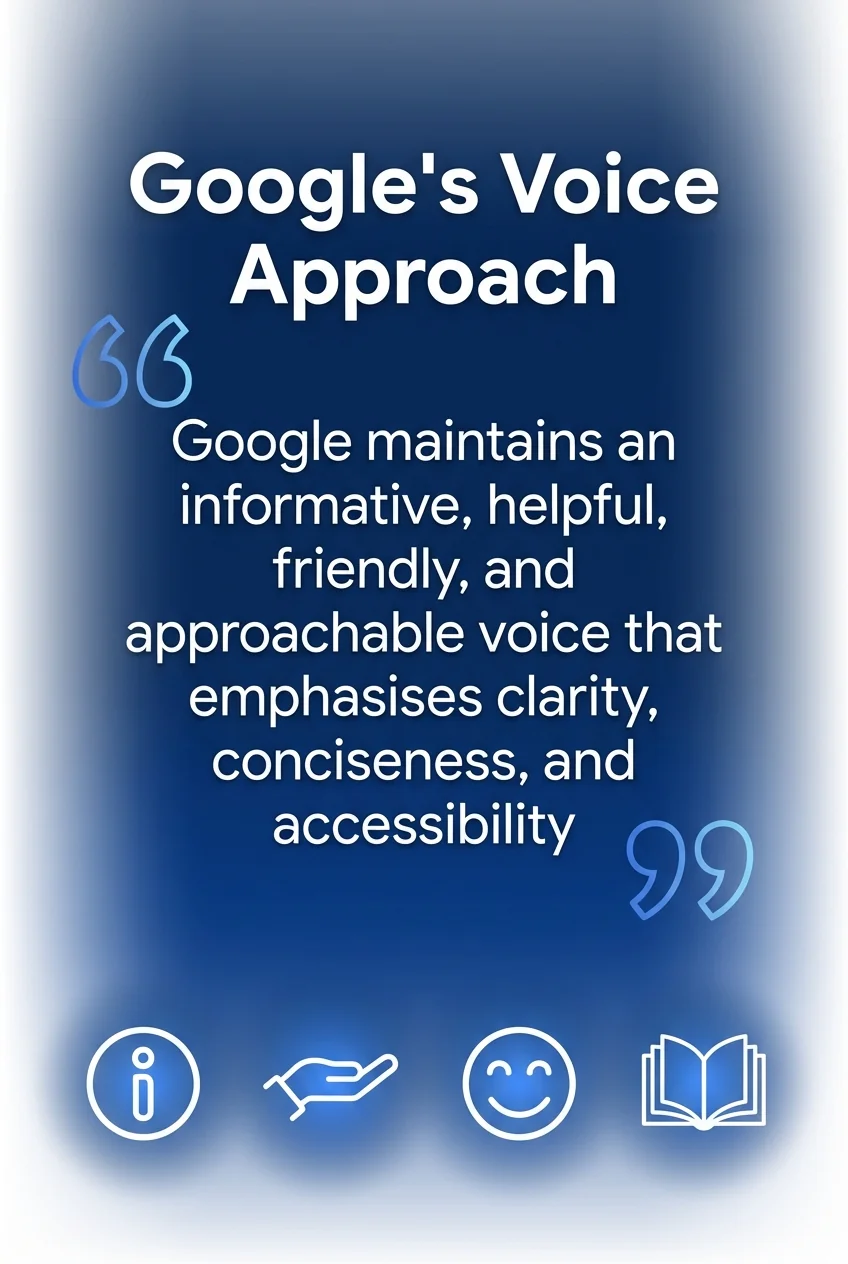
Google maintains an informative, helpful, friendly, and approachable voice that emphasises clarity, conciseness, and accessibility. Their communication prioritises user understanding above everything.
The voice feels authoritative without being intimidating. Complex technology becomes understandable through clear, simple language.
This consistency builds trust. Users know Google will communicate clearly regardless of the topic.
Key Lessons from Successful Brand Voices
Several patterns emerge from studying successful brand voices:
- Authenticity matters more than perfection
- Consistency builds recognition and trust
- Clear personality traits guide all content
- Adaptation respects context without losing identity
- Real communication beats corporate speak
These lessons inform your own brand voice development. Study brands you admire and analyse what makes their voices effective.
Personal branding principles often apply to company brands. Authenticity and consistency drive success in both contexts.
Implementing Your Brand Voice: Practical Next Steps
Creating brand voice guidelines is just the beginning. Implementation determines whether your documented voice becomes reality.
Start with team training. Everyone needs to understand the guidelines and see practical examples.
Review existing content against your new standards. Identify gaps between current communication and desired brand voice.
Training Your Team on Brand Voice Guidelines
Schedule dedicated training sessions. Walk through the style guide section by section.
Use interactive exercises. Have team members practise transforming generic content into on-brand messaging.
Create feedback loops. Regularly review content together and discuss whether it matches guidelines.
Establish approval processes for learning. New content creators should have work reviewed until they consistently match your brand voice.
Building Brand Voice into Your Workflow
Integrate brand voice checks into content creation processes. Make them a standard step rather than an afterthought.
Use templates and frameworks that naturally incorporate voice guidelines. Structure helps maintain consistency.
Create quick reference guides for common scenarios. Writers shouldn’t need to read the entire style guide for every post.
Tools like Grammarly can help maintain consistent tone, though human judgement remains essential.
Measuring Brand Voice Effectiveness
Track how your brand voice performs. Monitor engagement rates, sentiment analysis, and brand recognition metrics.
Conduct periodic brand perception surveys. Ask customers how they perceive your personality and whether it resonates.
Analyse which content types and voice applications drive strongest results. Refine your approach based on performance data.
Successful brand voice implementation shows up in metrics. Engaged audiences, growing followings, and positive sentiment indicate effective voice application.
Developing Your Voice Over Time
Brand voice isn’t static. It naturally develops as your company grows and your audience shifts.
Review guidelines annually. Ensure they still reflect your brand identity and resonate with current audiences.
Stay authentic to your core personality whilst allowing natural development. Growth shouldn’t mean complete reinvention.
Document changes clearly. When you refine personality traits or adjust applications, update guidelines and communicate changes to your team.
Successful social media campaigns consistently apply strong brand voice. The connection between voice and campaign performance becomes clear over time.
Moving Forward with Your Brand Voice Guide
You now have a complete framework for creating effective brand voice guidelines. The process moves from research through definition to documentation and application.
Start with audience research and mission clarity. These foundations inform every subsequent decision about personality and communication style.
Define 3-5 core personality traits that reflect your brand identity. Document them thoroughly with examples, boundaries, and platform-specific applications.
Create comprehensive style guides your team can actually use. Make them accessible, practical, and regularly updated.
Remember that consistency builds trust. Your brand voice becomes more recognisable and valuable with every piece of content that matches your guidelines.
Begin today. Review your current social media content and identify where your voice feels inconsistent. That analysis provides your starting point for creating stronger, more effective brand voice guidelines.